
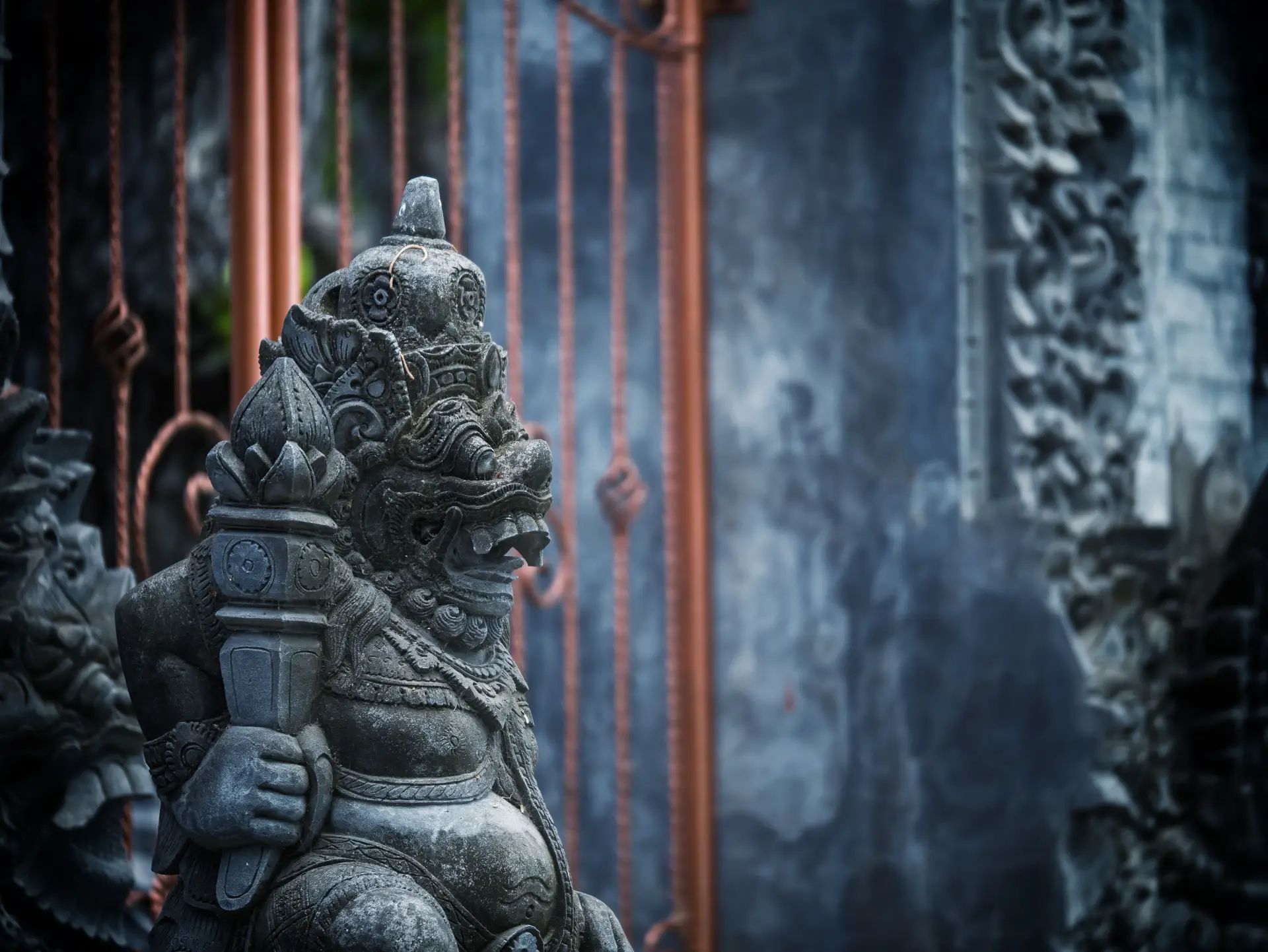
Introduction: The Living Bridge Between Worlds
To walk through Bali and truly grasp the deep Balinese statues meaning is to enter an open-air sanctuary where stone, wood, and bronze are infused with breath, intention, and divine presence. Along winding village lanes, guarding dark temple gateways, or nestled in the shade of ancient banyan trees, Balinese statues stand as quiet sentinels over the island’s daily life. Yet, to view these works merely through the lens of aesthetic appreciation or decorative craft is to miss their true purpose. In Balinese Hindu culture, art is never an exercise in self-expression or commercial display; it is a profound act of spiritual service known as Ngayah.
Table of Contents
Ngayah represents the selfless offering of one’s skills, time, and labor to the divine and the community without expecting material reward. When a master carver shapes stone, every stroke of the chisel is an act of prayer.
Driven by Ngayah, Balinese statues serve as a living bridge between the human realm (Bhuta Loka), nature (Bhuana Agung), and the unseen divine world (Swah Loka). These sculpted figures do not merely depict gods and demons—they act as intentional conduits through which cosmic energies are grounded, balanced, and harmonized. To understand the Balinese statue is to uncover the foundational philosophy of Balinese Hinduism itself: a dynamic equilibrium where sacred and profane, light and dark, visible (Sekala) and invisible (Niskala) continuously interlace.
Section 1: Statues as Works of Art – Tradition vs. Modernity
The Sacred Canon: Asta Kosala Kosali and Ugari
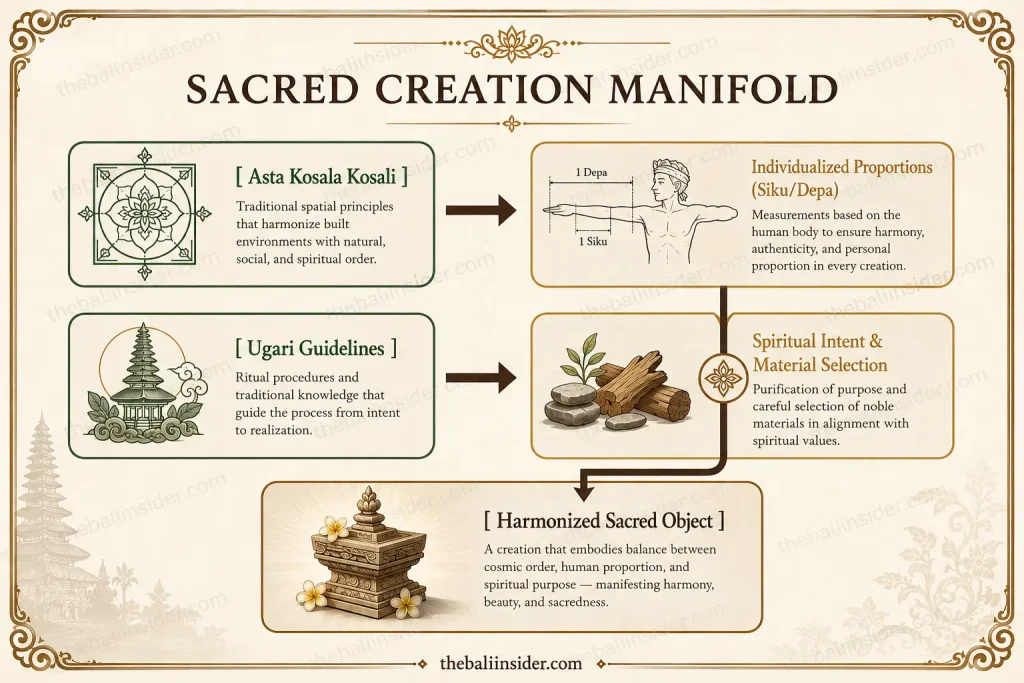
The creation of traditional Balinese statues is strictly governed by ancient canons rather than personal artistic caprice. Master carvers follow Asta Kosala Kosali—the traditional Balinese architectural and iconometric manual rooted in Vedic manuscripts—alongside Ugari, the unwritten custom and spiritual guidelines passed down through generations.
Under Asta Kosala Kosali, proportions are strictly individualized using the carver’s or patron’s body measurements (such as siku, depa, and musti). These dynamic measurements ensure that every object created exists in spiritual resonance with its human custodian. A statue carved to protect a specific family household carries physical proportions derived from the head of that household, forging a unique metaphysical bond between owner, object, and space.
Regional Styles: Sukawati, Batubulan, Mas, and Ubud
Balinese sculpture is not a monolith; each region (Banjar or village) developed distinct stylistic idioms shaped by geography, local stone availability, and historical patronage:
- Sukawati & Batubulan: Renowned for heavy, voluminous stone carvings carved from Paras—a soft, porous volcanic tuff harvested from local riverbeds. The statues of Batubulan exhibit deep undercuts, dramatic expressions, and intricate relief work that weathers into soft mossy textures over time.
- Mas Village: The historic heartland of Balinese woodcarving. Artisans here specialize in dense hardwoods like teak, hibiscus (waru), and ebony. Statues from Mas traditionally depict mythic figures from the Ramayana and Mahabharata with long, flowing lines and exquisite, fluid contours.
- Ubud: Historically the center of royal patronage, Ubud carvers refined decorative complexity, bringing hyper-detailed flourishes to mythic heroes, celestial nymphs (Apsaras), and divine avatars.
The 1930s Paradigm Shift: The Pita Maha Movement
Prior to the 20th century, Balinese art was almost exclusively anonymous and dedicated entirely to temple or court functions. This changed dramatically in 1936 with the founding of the Pita Maha Art Association by the Prince of Ubud, Tjokorda Gde Agung Sukawati, along with Western artists Walter Spies and Rudolf Bonnet.
Pita Maha encouraged local carvers to explore secular themes, individual self-expression, and refined stylistic nuances without sacrificing traditional craft quality. Woodcarvers in Mas and Pujung began producing sleek, elongated human figures, everyday village scenes, and stylized anatomical studies. This movement established a dual identity in Balinese sculpture that persists today: high-art secular sculpture intended for international collectors, and strictly consecrated, rule-bound sacred statuary intended for temple sanctums.
Section 2: Statues as Visual Symbols – Texts Made Visible
The Semiotics of Sacred Form
To the initiated viewer, a Balinese statue is an open book. Every curve, facial expression, posture, hand gesture, and handheld object forms an intricate semiotic system designed to communicate complex theological truths across generations.
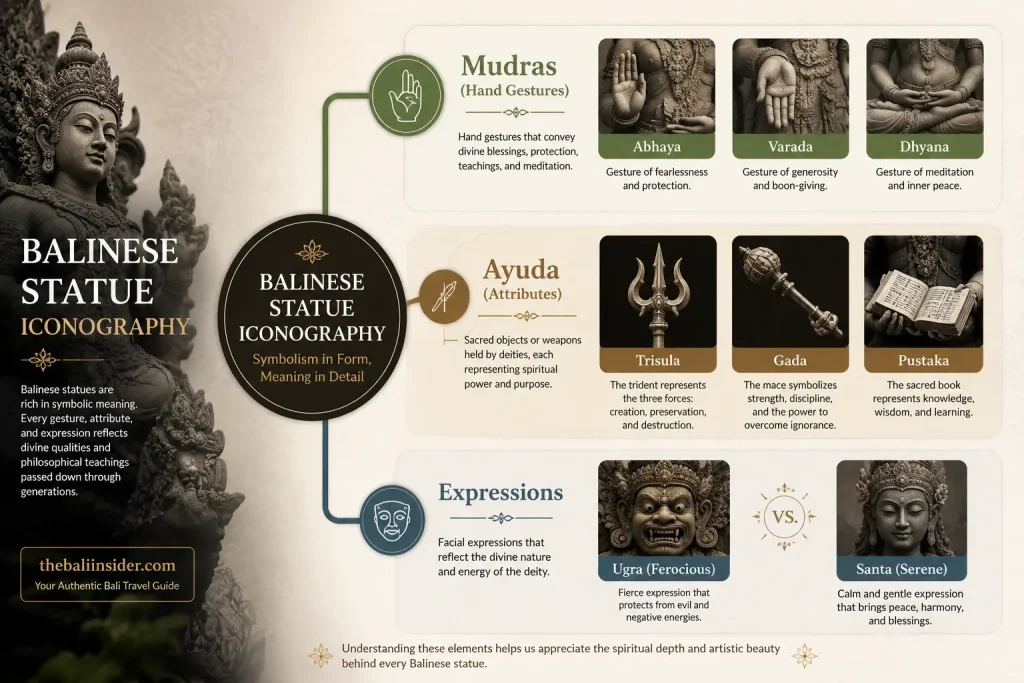
1. Mudras (Sacred Hand Gestures)
- Abhaya Mudra (Hand raised, palm facing outward): The sign of fearlessness, protection, and divine reassurance. Common in depictions of Shiva and Wisnu.
- Varada Mudra (Hand lowered, palm open outward): The gesture of compassion, charity, and the bestowing of boons.
- Dhyana Mudra (Hands resting in lap, palms upward): The gesture of deep meditation, characteristic of contemplative deities and ascetics.
2. Ayuda (Divinity Attributes and Weapons)
- Trisula (Trident): The attribute of Lord Shiva, signifying the destruction of ego and the mastery over the three cosmic qualities (Triguna).
- Gada (Mace): Held by Lord Bima or Wisnu, representing cosmic strength, righteousness (Dharma), and the destruction of ignorance.
- Pustaka (Sacred Palm-Leaf Manuscript): Held by Goddess Saraswati, denoting ultimate spiritual wisdom, art, and the sciences.
3. Facial Typology: Ugra vs. Santa
- Ferocious (Ugra): Bulging eyes (nyelerek), exposed tusks (taring), wild hair, and aggressive postures. These attributes do not signify evil; rather, they represent divine power mobilized to intimidate negative energies (Bhuta Kala) and ward off chaos.
- Serene (Santa): Symmetrical, almond-shaped eyes, smooth brows, gentle smiles, and composed posture. These forms convey inner mastery, transcendent peace, and supreme wisdom.
Epistemology of Symbolism: Pratika and Animal Symbolicum
The deep symbolic nature of Balinese statuary aligns directly with classical Sanskrit theological frameworks and modern cultural philosophy. In Hindu iconography, statues operate under the concept of Pratika—a Sanskrit term signifying a physical image or visual symbol that points the human mind toward an abstract, formless Divine Reality (Brahman).
As scholar I Made Titib (2003) notes, citing Ardhendu Serkhar Gosh (1993), the finite human intellect cannot readily focus on the unmanifest and infinite without a physical anchor. The Pratika provides that anchor, acting as a visual intermediary.
This mirrors the philosophical framework of Ernst Cassirer, who defined human beings as Animal Symbolicum—creatures who perceive and structure reality exclusively through symbolic forms. The Balinese statue is a prime example of this: a physical manifestation of complex mythological texts, cosmic laws, and philosophical principles rendered visible and tangible for the community.
Section 3: Statues as Sacred Entities – From Profane Stone to Pratima
The Metamorphosis: Melaspas and Pasupati Rituals
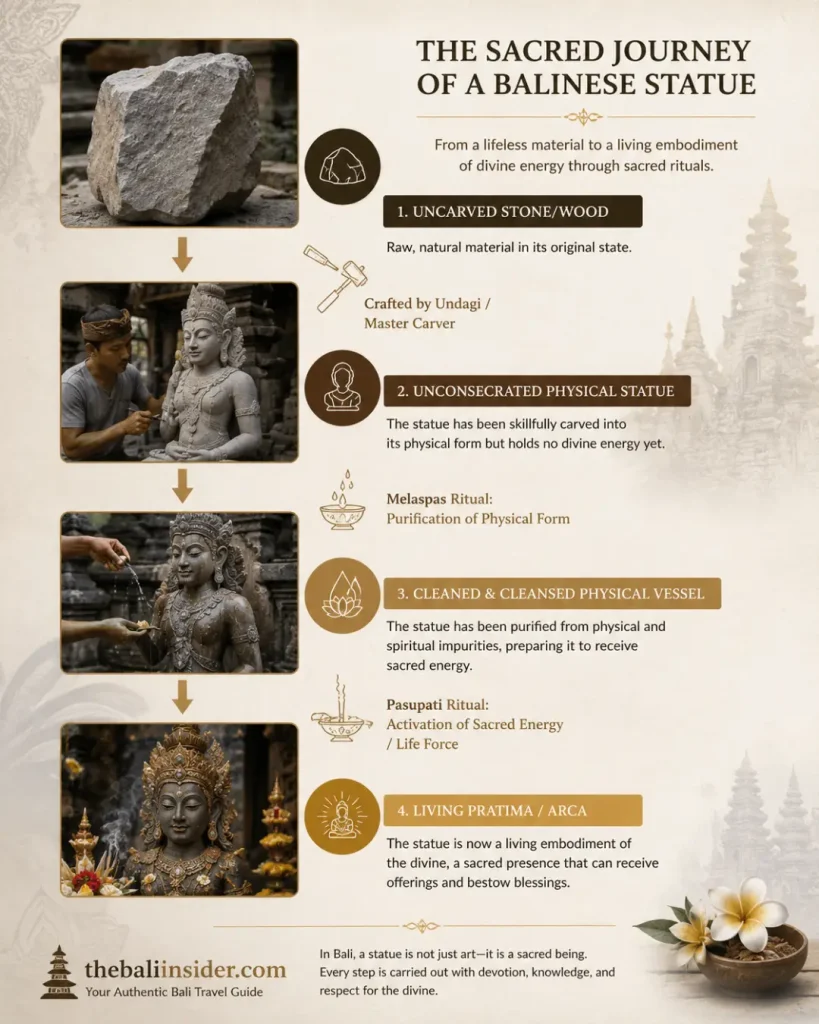
A newly carved stone figure in Bali is merely a piece of shaped rock (profane) until it undergoes rigorous liturgical transformation. The journey from dead matter to a living vessel of sacred energy involves two critical rituals administered by high priests (Pedanda) and ritual specialists:
1. The Melaspas Ritual
Melaspas is the cleansing and purification ceremony applied to newly constructed buildings, shrines, and statues. Its purpose is to ask forgiveness from nature for disturbing the raw materials (wood or stone) and to cleanse the object of any negative subtle influences acquired during its creation. The ritual recalibrates the object’s elements (Panca Maha Bhuta—earth, water, fire, air, ether) into harmony.
2. The Pasupati Ritual
While Melaspas purifies the physical vessel, Pasupati breathes spiritual life force (Prana) into it. During Pasupati, the Pedanda inscribes sacred esoteric syllables (Modre) onto small pieces of gold, silver, or mirror glass (Rajah), which are inserted into a secret cavity inside the statue. Through deep meditation, mantras, and mudras, the priest invites the divine energy (Ista Devata) to temporarily inhabit the physical form, transforming it into a sacred Pratima.
The Master Craftsman: The Undagi as Spiritual Medium
The carver of a sacred statue is known as an Undagi. An Undagi is not merely an artisan; they are a recognized spiritual practitioner who must maintain strict ritual purity (Meweda or Nyuci), observe fasts, and perform offerings before touching chisel to stone.
If an Undagi carves without spiritual purity or violates the proportions dictated by Asta Kosala Kosali, the statue is believed to become vulnerable to malicious spirits (Bhuta), bringing illness, disharmony, or misfortune to the household or village that houses it.
Sociological Functions: Sakral and Social Order
The presence of consecrated statues shapes the daily social structure of the Balinese village (Desa Adat). In his seminal work on Balinese cultural sociology, Prof. Dr. I Gusti Agung Putra Triguna (2011) explores how the humanistic concept of the “Sacred” (Sakral) functions as a primary mechanism for social cohesion and behavioral regulation.
“The Sacred (Sakral) in Balinese society is not a distant, abstract theological construct; it is an active social force that defines physical space, regulates collective behavior, and establishes absolute boundaries of respect within the community.”
— I G. A. P. Triguna (2011)
When a statue is consecrated and placed at a crossroads, temple gate, or household shrine, it transforms that physical space into a sacred zone. Community members adjust their language, dress, posture, and actions when near these figures. The statue acts as an external moral compass, reminding individuals of their obligations to divine law (Dharma) and community harmony (Tri Hita Karana).
Section 4: Classification Taxonomy of Balinese Statues
To help navigate the vast diversity of statues found across Bali, the following taxonomy categorizes figures by their spiritual tier, primary location, materials, and sacred function (referencing ritual framework insights from Suwantara & Suyoga, 2014):
| Category | Primary Location | Typical Materials | Spiritual Status | Primary Function |
| Pratima / Pralingga | Inner Temple Sanctum (Utama Mandala) | Precious woods (Sandalwood), Gold, Silver, Coins (Kepeng) | Highly Sacred (Sakral Utama) | Serves as the temporary physical vessel (Pramana) for deities during major temple anniversaries (Odalan). Kept hidden when not in use. |
| Arca | Temple Pavilions & Courtyards (Madya Mandala) | Hard stone (Paras Kerobokan), Bronze, Andesite | Sacred (Sakral) | Represents specific deities (e.g., Ganesha, Saraswati, Wisnu) for daily veneration, prayer focus, and ritual offerings. |
| Bedogol (Dwarapala) | Flanking Temple Gates (Candi Candi) & House Entrances | Volcanic Ash (Paras Batubulan), Black Lava Stone | Protective Sacred | Guardian figures (e.g., Mahakala & Nandishvara or mythic Raksasa) designed to filter out negative energies (Bhuta Kala) before entering a gateway. |
| Togog / Decorative | Hotels, Gardens, Art Galleries, Private Estates | Soft sandstone, Teak wood, Cast concrete, Fiber | Profane / Secular (Nista / Non-Sacred) | Artistic appreciation, interior design, cultural homage, and modern commercial aesthetics. Unconsecrated. |
Section 5: Daily Ritual Rhythms, Tourism & Visitor Etiquette
The Rhythms of Veneration: Odalan, Purnama, Tilem, and Kajeng Kliwon
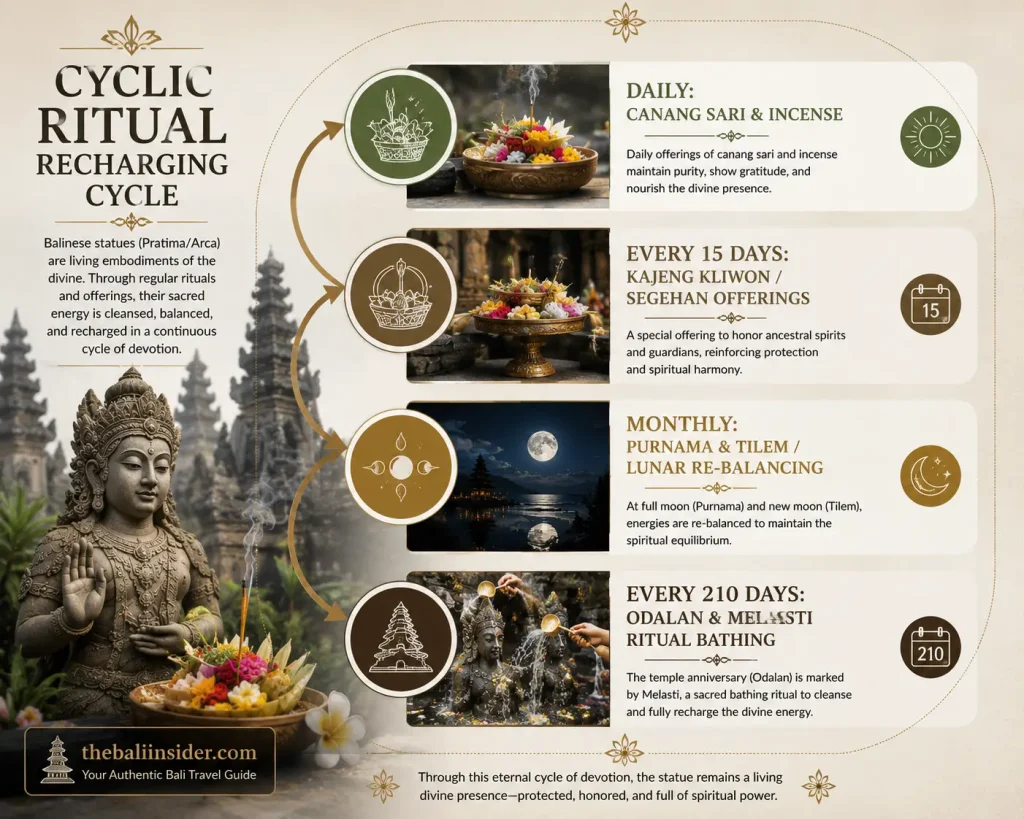
Consecrated statues in Bali are not static monuments; they are active participants in the island’s cyclic ritual life. As documented by Suwantara & Suyoga (2014), the spiritual energy of sacred statues is systematically maintained through periodic ritual offerings timed to cosmic cycles:
- Odalan: The temple’s bi-annual anniversary (occurring every 210 days according to the Pawukon calendar). Consecrated Pratima are brought out from inner sanctums, bathed in holy water in elaborate processions (Melasti to the sea or sacred springs), dressed in sacred textiles, and offered elaborate ceremonial banquets.
- Purnama (Full Moon) & Tilem (New Moon): Monthly lunar pivots where statues receive fresh flower garlands (Canang Sari), incense, and holy water drops to sustain their cosmic balance.
- Kajeng Kliwon: A day occurring every 15 days when the energetic boundary between the visible (Sekala) and invisible (Niskala) grows thin. Guardian statues (Bedogol) receive specific offerings (Segehan) on the ground to pacify chaotic subterranean energies.
The Poleng Cloth: Fabric of Sacred Balance
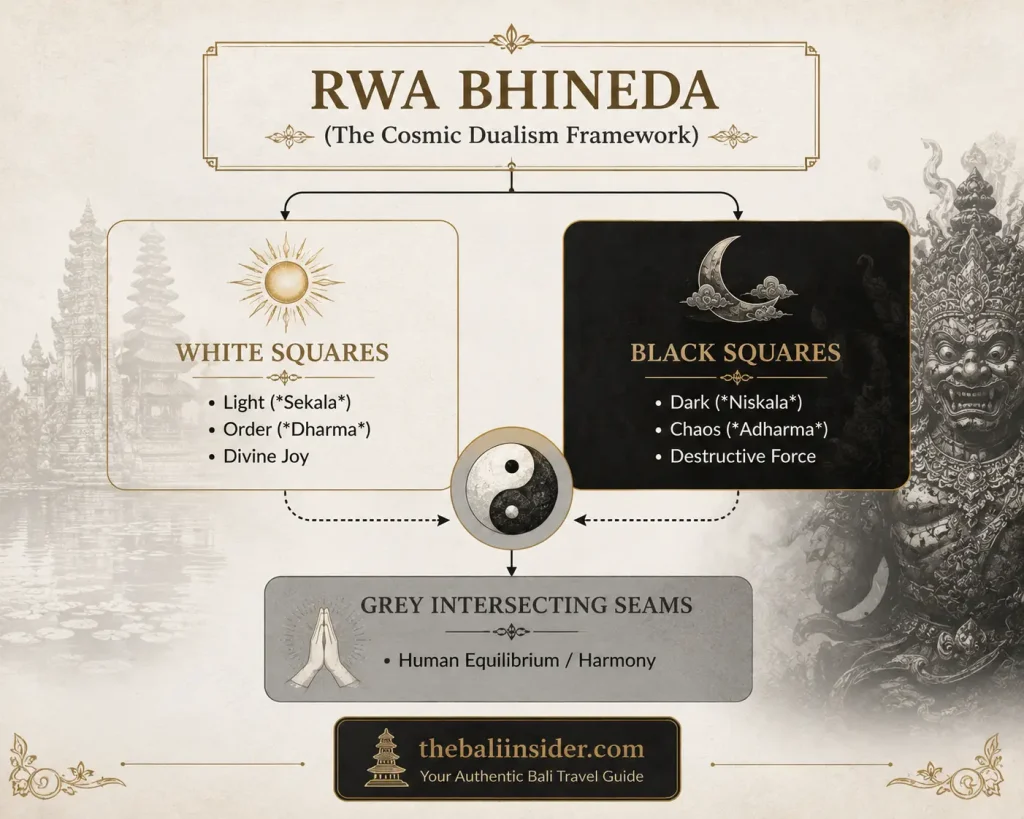
Visitors frequently notice statues wrapped around the waist in a black-and-white checkered cloth known as Kain Poleng. This fabric is a visual representation of Rwa Bhineda—the core Balinese philosophy of dualistic balance.
The alternating black and white squares do not represent good defeating evil; rather, they signify that order and chaos, light and dark, joy and suffering are inseparable components of the same cosmic reality. Wrapping a statue in Kain Poleng signals that the object is actively working to balance these opposing forces within its immediate space.
Modern Challenges: Commercialization vs. Sanctity
With the rapid expansion of global tourism, Balinese statuary faces a complex reality. Mass production of concrete and cast resin statues for export has created a thriving commercial economy. However, it has also led to sacred icons being placed inappropriately—such as using heads of divine figures as garden ornaments, pool decorations, or nightclub accessories in foreign countries.
For the Balinese, treating a sacred form purely as a decorative trinket divorces the object from its spiritual reality (Niskala). Cultural preservationists and local religious councils (PHDI) continually advocate for respectful awareness regarding how these forms are purchased, displayed, and represented globally.
Balinese Temple Etiquette: Visitor Guidelines
When visiting temples (Pura) or villages in Bali, tourists and researchers should observe proper etiquette when interacting with or photographing statues:
- Dress Appropriately: Always wear Balinese traditional attire.
- Do Not Touch Consecrated Figures: Avoid touching Pratima, Arca, or Bedogol that are wrapped in Kain Poleng or yellow/white cloths.
- Mind Your Physical Level: Never sit or stand higher than a sacred statue or a high priest. The head is considered the most sacred part of the body in Balinese culture; touching the head of a statue—or leaning on it—is a severe cultural offense.
- Menstruation Restrictions: In alignment with traditional purity rules (Sebel), individuals who are menstruating or grieving a recent family death should refrain from entering temple inner sanctums where Pratima are housed.
- Photograph Respectfully: Always maintain a respectful distance when photographing statues during active ceremonies. Avoid stepping over offerings (Canang Sari) placed at the base of statues.
Conclusion & Further Exploration
Balinese statues are far more than extraordinary feats of stone craftsmanship and artistic talent. They are physical vessels designed to hold spiritual meaning, living embodiments of ancient Hindu theology, and functional guardians of communal harmony. Through the sacred hands of the Undagi, the precision of Asta Kosala Kosali, and the transformative power of rituals like Melaspas and Pasupati, raw stone and wood become physical channels for the unmanifest divine.
By learning to read the symbolism embedded in every mudra, weapon, and facial feature, we begin to see the island of Bali as its people do: a dynamic, balanced cosmos where art, devotion, and daily life are inextricably bound together.
Read also Types of Balinese Statues
