
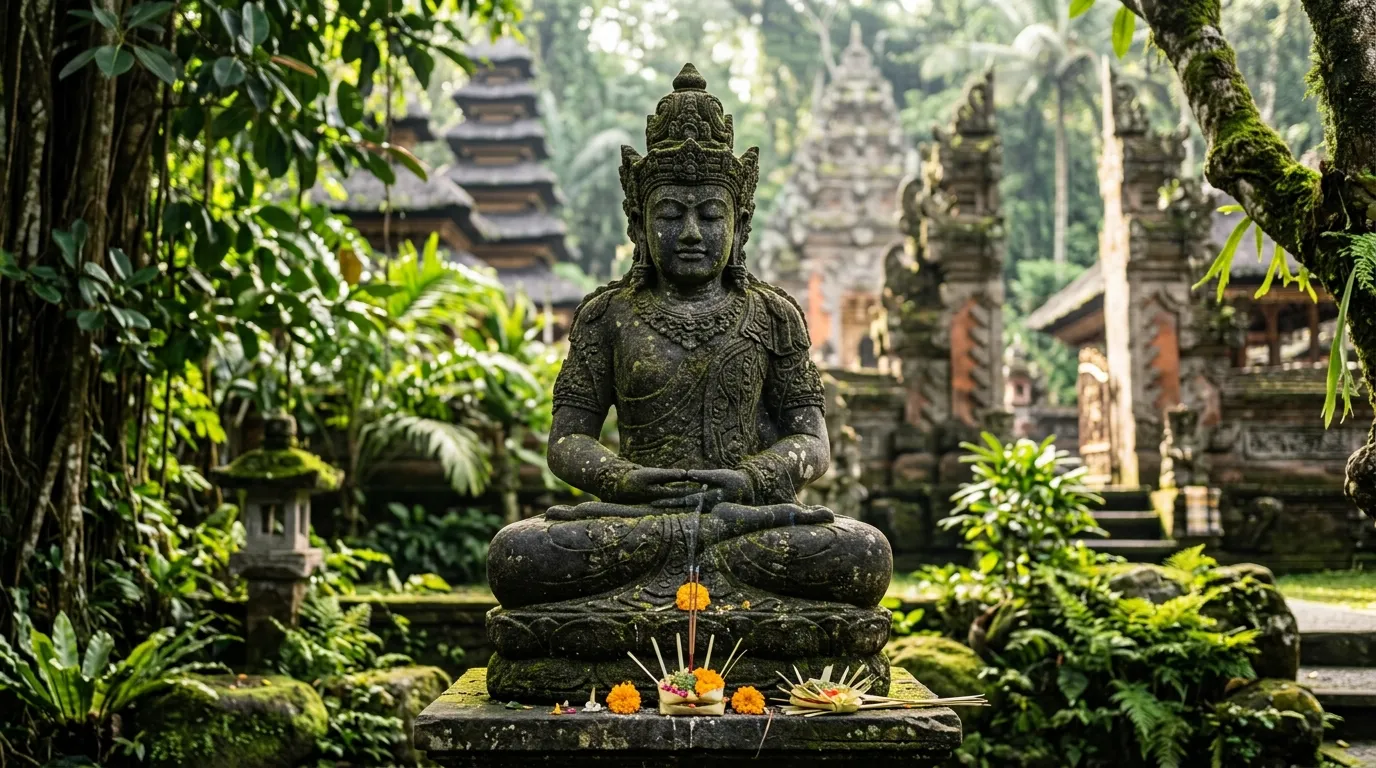
Understanding a Balinese statue hand gestures mudra is like reading a silent, ancestral language carved directly into stone. To the casual observer strolling through the quiet courtyards of Ubud or the towering split gateways (Candi Bentar) of Besakih, Balinese statues might appear as mere decorative art—exquisite examples of tropical stonemasonry rendered in soft volcanic paras stone or dark basalt. However, through the lens of semiotics—the study of signs, symbols, and how meaning is constructed—these statues reveal themselves to be something far more profound: they are visual scriptures..
In a culture traditionally rooted in oral transmission and ritual practice, sacred sculptures functioned as physical manifestations of esoteric Vedic philosophy. Long before literacy in ancient Old Javanese (Kawi) or Sanskrit was widespread among the general public, stone sculptors (Undagi) translated high theological concepts into concrete visual iconography. A single gesture of the fingers, the curve of a wooden trident, or the exaggerated bulge of a guardian’s eye carried an entire theological discourse regarding the cosmos, morality, and the delicate equilibrium between order and chaos.
By decoding the semiotic elements embedded within Balinese iconography—specifically hand gestures (Mudras), divine weaponry (Ayuda), facial expressions, and sacred geometry—we unlock the hidden spiritual maps carved directly into the island’s landscape.
Section 1: The Language of Hands – Understanding Mudras
In Balinese sacred iconography, the hands are never static or accidental. They are dynamic transmitters of cosmic energy and spiritual intent. Derived from ancient Sanskrit roots meaning “seal,” “mark,” or “gesture,” a Mudra is a precise physical posture of the hands and fingers designed to evoke specific psychological states, invoke divine energies, or communicate spiritual principles to the devotee.
When an Undagi carves a deity or an enlightened ancestor, the hand gesture serves as the primary iconographic signifier that establishes the figure’s theological function within the temple complex (Pura).
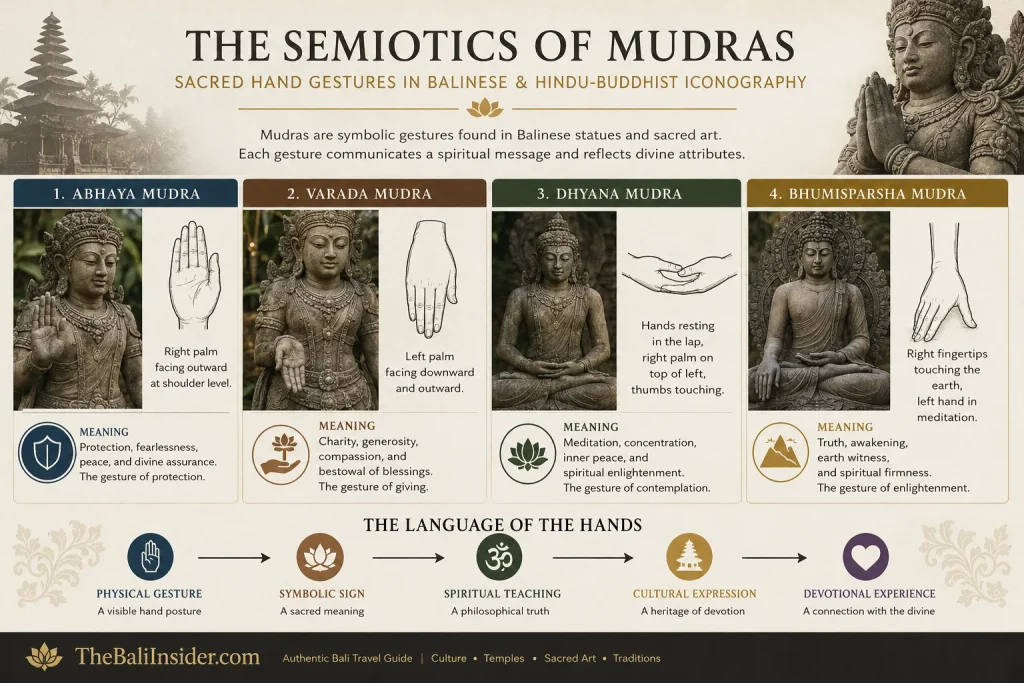
1. Abhaya Mudra: The Gesture of Reassurance and Protection
Perhaps the most universally recognized gesture across Balinese Hindu-Buddhist iconography is the Abhaya Mudra. Rendered with the right hand raised to chest level, palm facing outward, and fingers extended upward, this sign communicates the immediate cessation of fear.
From a semiotic perspective, the outward-facing palm functions as both an energetic shield and a welcoming gesture:
- Signifier: The raised, open palm facing the viewer.
- Signified: Divine protection, the dispelling of fear (abhaya), peace, and spiritual refuge.
- Balinese Cultural Context: In Balinese temples, statues exhibiting the Abhaya Mudra are frequently positioned near entryways or within the middle courtyard (Madya Mandala). They signify to worshippers that upon entering the sacred perimeter, they are under the immediate protection of the divine, shielded from malicious earthly and unseen forces (Bhuta Kala).
2. Varada Mudra: The Gesture of Infinite Generosity and Compassion
Often paired as a counterweight to the Abhaya Mudra, the Varada Mudra is executed with the hand hanging downward, palm facing outward toward the devotee, and fingers gently relaxed or extended.
- Signifier: Downward-pointing open palm.
- Signified: The bestowal of boons, charity, compassion, and the unbounded grace of the divine.
- Theological Meaning: While Abhaya represents divine power protecting the devotee against external harm, Varada signifies divine mercy flowing toward the worshipper. When a deity like Dewi Sri (the goddess of rice, fertility, and prosperity) is depicted in Balinese carving, her left hand frequently rests in Varada Mudra, visually promising physical sustenance and spiritual wealth to those who maintain cosmic harmony.
3. Dhyana Mudra: The Sacred Basin of Absolute Meditation
The Dhyana Mudra is the gesture of profound contemplation, inner stillness, and cosmic absorption. Typically seen on seated deities—particularly manifestations of Lord Shiva in his ascetic form (Shiva Mahadeva) or Dhyani Buddhas in syncretic Balinese Buddhist sanctuaries—this gesture requires both hands to rest flat on the lap. The right hand rests atop the left, palms facing upward, with the tips of the thumbs lightly touching to form a subtle, energetic triangle.
- Signifier: Overlapped palms in the lap forming an enclosed triangular shape.
- Signified: Concentration, total equilibrium, the union of wisdom and method, and the neutralization of worldly distractions.
- Esoteric Symbolism: The triangle formed by the thumbs represents the triple flame of divine knowledge burning within the heart chakra. It signals that the deity is in a state of Samadhi—the ultimate state of meditative absorption where subject and object merge into oneness.
4. Bhumisparsha Mudra: Calling the Earth to Witness
Although primarily rooted in Buddhist traditions, the Bhumisparsha Mudra (“Earth Touching Gesture”) heavily influenced Balinese syncretic art during the East Javanese Majapahit era (13th–16th centuries). In this gesture, the right hand hangs over the right knee, reaching downward so the fingertips lightly graze the earth or the lotus throne beneath, while the left hand rests open in the lap.
- Signifier: Right fingertips touching the earth.
- Signified: Absolute truth, steadfastness, unshakable resolve, and the triumph over temptation.
- Semiotic Narrative: This gesture encapsulates a pivotal mythic moment: when the seeker calls upon the Mother Earth itself as an infallible witness to their spiritual purity and right to claim enlightenment against the illusions of Maya (delusion).
Section 2: Sacred Weapons (Ayuda) and Cosmic Power
While hand gestures communicate internal spiritual states, the held attributes—known collectively as Ayuda (sacred weapons or divine implements)—represent the active, cosmic power (Shakti) through which the gods govern, maintain, and dissolve the universe.
In Balinese Hinduism (Agama Hindu Dharma), divine weapons are not instruments of worldly violence. Instead, they are metaphysical tools designed to sever ego (Ahamkara), dismantle ignorance (Avidya), and maintain cosmic order (Rta). They are intrinsically tied to the Dewa Nawa Sanga—the nine directional deities that govern Balinese spatial cosmology.
1. Shiva’s Trisula (The Sacred Trident)
Lord Shiva holds the central position in the Balinese divine pantheon as the Supreme Destroyer and Transformer (Pramesti Guru or Siwa Pasupati). His primary Ayuda is the Trisula (Trident), a weapon consisting of a central blade flanked by two curved outer prongs.
From a semiotic standpoint, the Trisula is an extraordinarily rich symbol encoding multiple cosmic triads:
- The Cosmic Cycle (Tri Murti): Creation (Sristi), Preservation (Sthiti), and Dissolution/Transformation (Pralaya).
- The Three Worlds (Tri Loka): Bhurloka (the underworld/material plane), Bhuvarloka (the atmosphere/subtle realm), and Swaraloka (the heavenly/causal realm).
- The Three Attributes of Nature (Tri Guna): Sattwam (purity/light), Rajas (action/passion), and Tamas(inertia/darkness).
When an artisan carves Shiva holding the Trisula, the message is clear: Shiva sits at the center of all three realms and holds complete authority over time, matter, and the cyclic nature of existence.
2. Brahma’s Kitab and Rosary: Knowledge and Eternal Cycles
Occupying the Southern direction in the Dewa Nawa Sanga system, Lord Brahma is the creator deity associated with the element of fire (Agni) and the color red. In Balinese sculpture, Brahma is rarely depicted with conventional weapons of war. Instead, his Ayuda consist of:
- Lontar / Kitab (Sacred Scriptures): Symbolizing absolute Vedic knowledge, creative intelligence, and the fundamental laws that structure the cosmos.
- Gani Tri / Aksamala (Prayer Beads/Rosary): Symbolizing the cyclical nature of time, infinite repetition, and the continuous focus required for spiritual self-realization.
Together, these attributes convey that creation does not occur through raw physical force, but through divine intellect, sacred sound (Mantra), and disciplined meditation.
3. Vishnu’s Chakra (The Divine Discus)
Positioned in the Northern direction and associated with the element of water and the color black or dark blue, Lord Vishnu is the preserver of cosmic order. His defining Ayuda is the Sudarshana Chakra—a spinning, razor-sharp wheel or discus forged from solar energy.
Semiotic Analysis of the Chakra:
- Form: A revolving circle with radiating spokes or flame-like serrations.
- Symbolic Meaning: The wheel of time (Kala Chakra), ultimate cosmic law, and the relentless destruction of ignorance.
- Cosmic Function: The Chakra moves through the universe at the speed of thought, decapitating demoniac forces—which, in Balinese philosophy, represent uncontrolled desires, arrogance, and spiritual disharmony. It cuts through illusion (Maya) to protect the moral order of the world.
4. The Dewa Nawa Sanga System: Weapons as Spatial Coordinates
In Balinese architecture and sculpture, every directional deity carries a specific weapon that doubles as an orientation signpost within a temple layout:
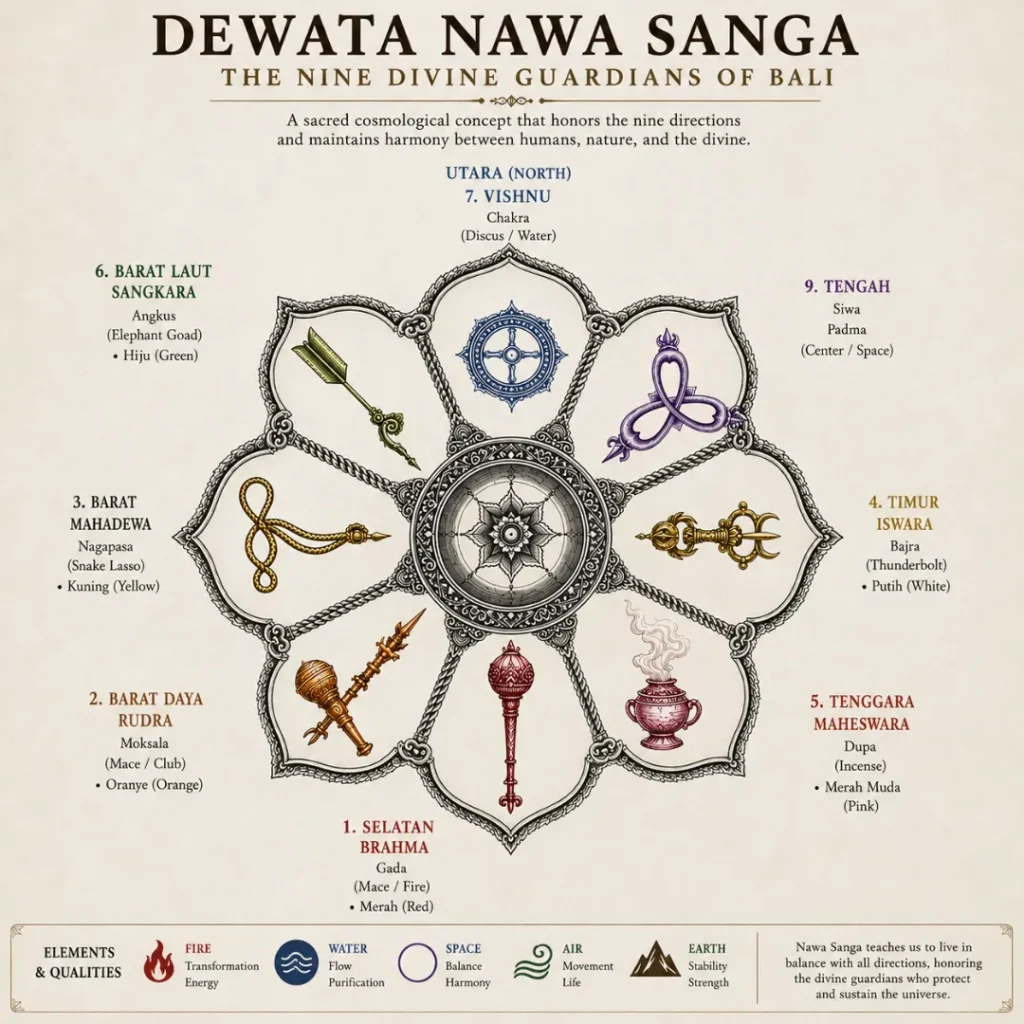
By recognizing these weapons in stone carvings, a knowledgeable practitioner or semiotician can immediately identify which deity is depicted and determine the orientation and ritual alignment of the surrounding sacred space.
Section 3: Why Are Balinese Statues Fierce? Unpacking Bhuta and Raksasa
For many first-time travelers to Bali, the most striking and perplexing encounters with local sculpture occur at the entrance gates of temples, villages, and private homes. There, instead of serene, smiling deities, one meets towering, demonic guardians with protruding fangs, bulging bloodshot eyes, terrifying grimaces, and muscular, crouching frames.
These figures are known as Dwarapala, Bhuta Kala, or Raksasa. To understand why sacred spaces are guarded by such terrifying iconography, one must examine Balinese ontology—specifically the concept of cosmic balance and dualism.
1. Bulging Eyes and Exposed Fangs: The Semiotics of Wrath
In Western art history, demonic imagery often represents unmitigated evil, corruption, or eternal damnation. In Balinese Hindu philosophy, however, the concept of absolute, irreversible evil does not exist. Rather, the universe is governed by Rwa Bhineda—the fundamental law of dualism, the inescapable interdependence of opposites: light and dark, order (Dharma) and chaos (Adharma), beauty and terror.
The ferocious visual features on a guardian statue serve specific semiotic functions:
- Bulging Eyes (Mata Belalak): Symbolize hyper-vigilance and absolute awareness. Nothing hidden or impure can slip past their gaze. They pierce through earthly hypocrisy and spiritual deception.
- Protruding Fangs (Taring): Represent raw, unrefined primordial energy capable of rending negative spiritual forces to pieces.
- Aggressive Stance (Mendak): A low-center-of-gravity squat, ready to leap into battle, signaling immediate defense of the sacred boundary.
2. Balancing the Panca Maha Bhuta (The Five Elements)
According to Balinese cosmogony, the material universe and the physical human body are composed of the Panca Maha Bhuta (Five Great Elements):
- Pertiwi: Earth (solid matter)
- Apah: Water (fluidity)
- Teja: Fire (transformation/heat)
- Bayu: Air/Wind (movement)
- Akasa: Ether/Space (the container of reality)
When these five elements exist in harmonious proportion, peace (Shanti) reigns. However, when these elements become turbulent or uncontrolled, they manifest as destructive spiritual entities known as Bhuta (elemental forces) and Kala(time/destruction).
The fierce statues carved at temple entrances are not evil spirits themselves; they are transformers of energy. By giving chaotic elemental forces a physical form through stone and offering them regular sacrifices (Segehan or Caru), the Balinese neutralize their destructive potential and convert them into protective guardians. The visual fierceness acts as a mirror that frightens away genuine spiritual negativity before it can enter the sacred inner sanctuary (Utama Mandala).
3. Taming the Six Inner Enemies: The Sad Ripu
On a psychological and interior level, the terrifying faces of Balinese guardians serve as a constant warning to worshippers regarding their own internal vices. In Balinese Hinduism, spiritual growth requires the mastery of the Sad Ripu (the Six Inner Enemies):
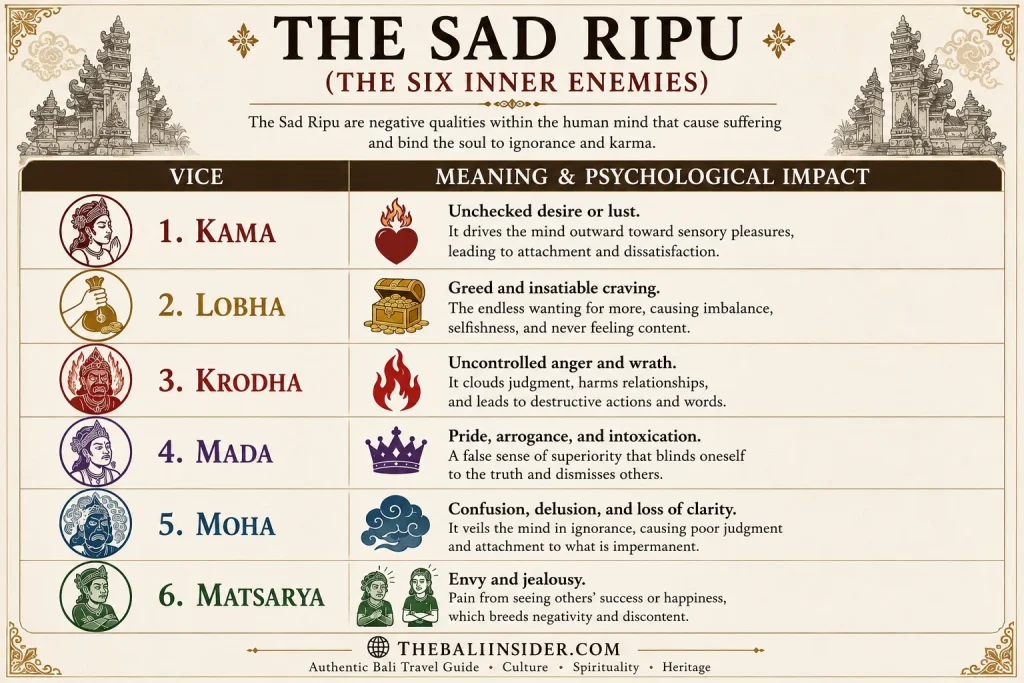
When a devotee steps past a terrifying Dwarapala guardian statue at the Candi Bentar gateway, the statue serves as an externalized visual representation of their own uncontrolled passions (Krodha, Mada, and Kama). The visual shock of the ferocious stone face demands an immediate internal audit: Have you subdued your inner demons before crossing into the presence of the divine?
Section 4: The Philosophy of Pratika and Visual Semiotics
To fully grasp the intellectual foundations of Balinese art, we must bridge modern semiotics with traditional Indian and Balinese aesthetics. In Western semiology (derived from Ferdinand de Saussure and Charles Sanders Peirce), a sign consists of a signifier (the physical form) and a signified (the mental concept).
In Balinese sacred theology, this dynamic is understood through the philosophical concept of Pratika—a Sanskrit and Old Javanese term referring to a physical symbol or concrete representation of an abstract, unmanifest deity.
1. Titib’s Framework: From Acintya to Manifest Form
As scholar I Made Titib articulates in his seminal 2003 work Teologi dan Simbol-Simbol Dalam Agama Hindu (Teology and Symbols in Hinduism), the divine ultimate reality in Balinese Hinduism—Ida Sang Hyang Widhi Wasa—is fundamentally Acintya: beyond human thought, formless, timeless, and incomprehensible to the finite human mind.
However, human consciousness requires concrete visual anchors to engage in devotion (Bhakti). This creates a theological necessity for Pratika:
“Symbols (Pratika) are not the gods themselves, but necessary bridges constructed from stone, wood, and metal that allow finite human consciousness to perceive and connect with the unmanifest ultimate reality (Acintya).” — I Made Titib (2003)
Titib classifies sacred symbols into three distinct semiotic tiers:
- Swarupa: The abstract, formless essence of divinity (represented in Balinese temples by the empty lotus throne, the Padmasana).
- Rupa: The figurative, anthropomorphic representation of divine qualities (statues of Brahma, Vishnu, Shiva, Saraswati, etc.).
- Pratima: Sacred objects, coins, or small wooden statues consecrated through ritual (Paspas) to serve as temporary physical vessels (sthana) for divine energy during temple festival days (Odalan).
2. Ghosh’s Theory of Visual Iconology
Complementing Titib’s theological structure, art historian M. Ghosh (1980) emphasizes that traditional South and Southeast Asian sacred iconography functions as a non-verbal cognitive system:
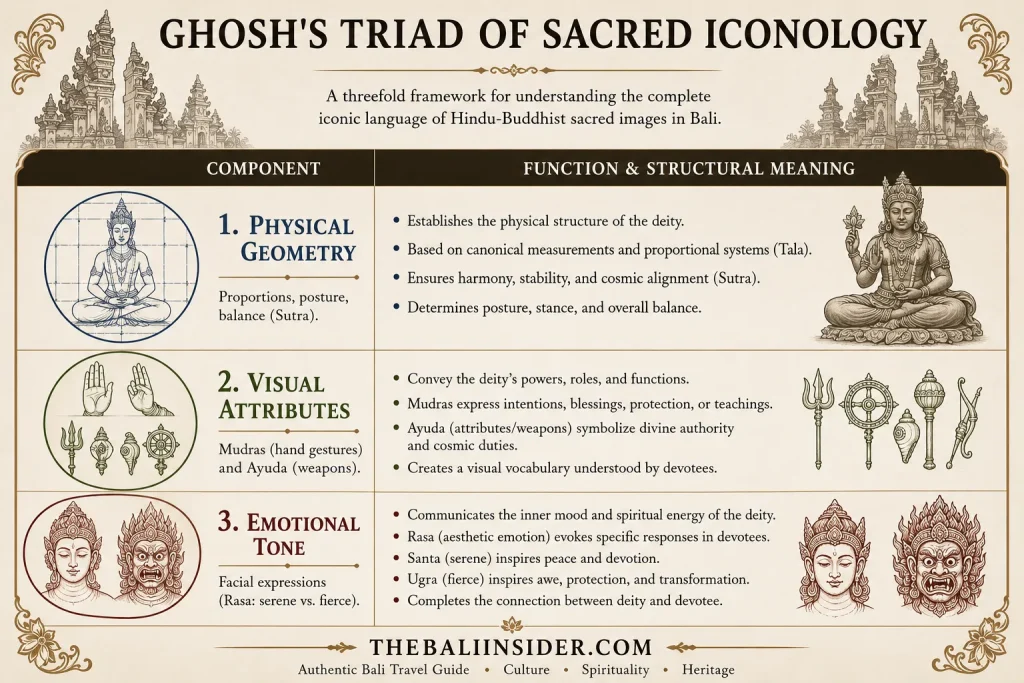
According to Ghosh, when these three elements converge within a sculpture, the artwork ceases to be mere static stone. It becomes a coded transmission system. The worshipper does not merely “look” at the statue; they undergo Darshan—a reciprocal sacred act of “seeing and being seen” by the divinity through the lens of consecrated symbols.
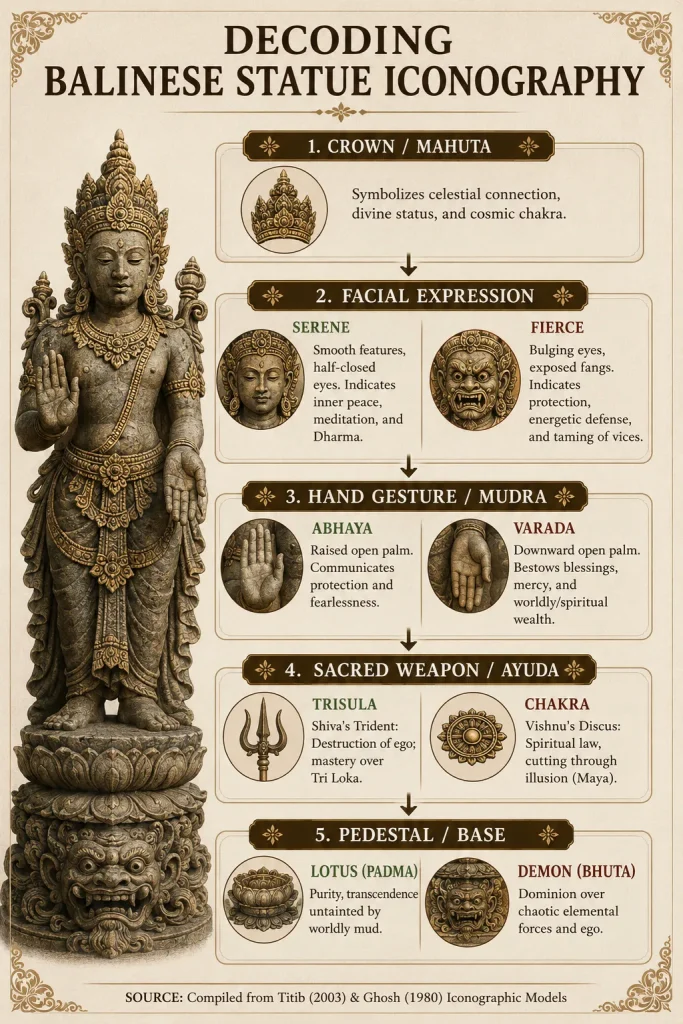
Visual Infographic: The Anatomy of Balinese Statue Iconography
To summarize how these distinct semiotic elements coalesce into a single unified sculpture, examine the structural diagram below. This visual breakdown demonstrates how an Undagi combines crown ornamentation, facial expression, hand gesture, weapon, and base posture to communicate a complete spiritual message.
Conclusion: Reading the Sacred Canvas of Bali
When you walk through the temple gateways of Bali, you are not merely viewing historic art; you are walking through an open-air library of spiritual semiotics. Every element carved into stone—from the gentle, reassuring palm of an Abhaya Mudra to the terrifying, vice-crushing fangs of a Dwarapala guardian—has been meticulously deliberate for centuries.
By learning to decode these visual signifiers, we move beyond surface aesthetics and enter the intellectual and spiritual world of the Balinese artisans. We discover that the fierce expressions do not invite terror, but offer deep spiritual protection; that the divine weapons do not wage war, but dismantle human ignorance; and that the subtle posture of a finger can invite the mind into profound, timeless contemplation.
🔗 Related Articles & Deep Dives
To expand your understanding of Balinese sacred art, spiritual philosophy, and temple architecture, explore our comprehensive cultural guides:
- Dive deeper into our main comprehensive guide on Balinese Statues Meaning & Spiritual Significance to explore how these sculptures function within daily temple rituals and domestic courtyard shrines.
- Learn how to identify different materials, historical carving styles, and regional variations in our detailed guide to the Types of Balinese Statues Across the Island.
Academic References & Sources
- Covarrubias, M. (1937). Island of Bali. Alfred A. Knopf.
- Eiseman, F. B. (1989). Bali: Sekala & Niskala (Volume I: Essays on Religion, Ritual, and Art). Periplus Editions. Library Catalog / Online Archive
- Ghosh, M. (1980). Development of Buddhist Iconography in Eastern India: A Study of Tara, Prajnas of Five Tathagatas and Bhrikuti. Munshiram Manoharlal Publishers. Research Record
- Ramseyer, U. (2002). The Art and Culture of Bali. Museum der Kulturen.
- Titib, I. M. (2003). Teologi dan Simbol-Simbol Dalam Agama Hindu [Theology and Symbols in Hinduism]. Paramita Surabaya. ISBN: 979-9257-76-X. University Library Record
