Table of Contents
- 1. The 2012 Inscription: Inscribing the Living Landscape
- 2. The Four UNESCO Clusters: Where Taman Ayun Fits
- 3. Criteria of Outstanding Universal Value (OUV): Cultural Criteria III, V, & VI
- 4. Modern Threats: Urbanization and Buffer Zone Preservation
- 5. The Conscious Visitor: How Tourism Funds Heritage Integrity
- 6. Verified Sources & Scholarly References
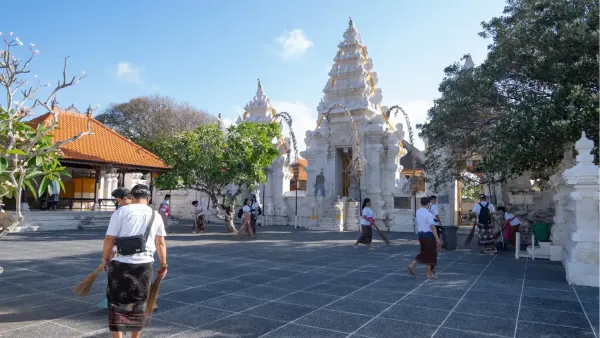
In July 2012, at its 36th session in Saint Petersburg, the UNESCO World Heritage Committee officially inscribed the Cultural Landscape of Bali Province: the Subak System as a Manifestation of the Tri Hita Karana Philosophy onto the prestigious World Heritage List. While the agricultural terraces of Jatiluwih and the water temple of Pura Ulun Danu Batur earned widespread international acclaim, the architectural jewel anchoring the southern cluster of this inscription is Pura Taman Ayun in Mengwi. Why did international heritage experts designate this 17th-century moated royal compound as an indispensable keystone of Bali’s living cultural heritage?
When organizing cultural itineraries across Badung Regency, confirm your mandatory provincial visitor contributions using the official Bali Tourist Levy & Entry Requirements Calculator, supporting ongoing UNESCO monument preservation.
1. The 2012 Inscription: Inscribing the Living Landscape
Unlike conventional UNESCO World Heritage properties—such as the Pyramids of Giza or the Colosseum—which are static archaeological ruins, Bali’s inscription was designated under the category of a living cultural landscape. It recognizes an active, working agrarian ecosystem that has sustained human life continuously for over a millennium.
UNESCO affirmed that Bali’s terraced landscapes were not shaped by top-down autocratic decree, but evolved from the ancient philosophical doctrine of Tri Hita Karana—maintaining harmony between humanity, the divine realm, and the natural environment. Pura Taman Ayun represents the absolute pinnacle where royal state governance, religious philosophy, and agricultural hydrology intersect.
The site's inclusion highlighted the sophisticated pre-modern governance systems of Southeast Asia. Long before the advent of computerized water modeling, the kingdom of Mengwi successfully balanced ecological preservation, democratic resource allocation, and aesthetic grandeur within an integrated water temple network that remains fully operational in the twenty-first century.
2. The Four UNESCO Clusters: Where Taman Ayun Fits
The UNESCO inscription is composed of four geographically distinct yet hydrologically connected clusters spanning central and southern Bali:
| UNESCO Cluster | Geographical Location | Cultural & Hydrological Role |
|---|---|---|
| Cluster 1: Lake Batur & Pura Ulun Danu | Kintamani Highlands (Bangli) | The supreme caldera headwater origin for all southern rivers. |
| Cluster 2: Pakerisan River Watershed | Tampaksiring (Gianyar) | Ancient 10th-century Warmadewa rock temples and sacred springs. |
| Cluster 3: Jatiluwih Rice Terraces | Slopes of Mt. Batukaru (Tabanan) | The grandest stepped terraced landscape cultivated with heirloom red rice. |
| Cluster 4: Royal Temple of Taman Ayun | Mengwi (Badung Regency) | The supreme royal water temple and master hydraulic reservoir of the southern plains. |
Taman Ayun provides the vital missing link in the narrative: demonstrating how regional kingdoms organized and maintained the physical infrastructure supporting the Subak network across political boundaries. Without the royal water temples channeling and dividing mountain waters, the egalitarian farming communities downstream would have lacked the physical engineering framework required to prevent catastrophic flash flooding during monsoons and severe water deficits during seasonal droughts.
3. Criteria of Outstanding Universal Value (OUV): Cultural Criteria III, V, & VI
To achieve inscription, a site must satisfy strict international criteria of Outstanding Universal Value (OUV). Pura Taman Ayun was recognized under three specific UNESCO cultural criteria:
The Three UNESCO Pillars
- Criterion (iii): Taman Ayun bears exceptional testimony to the cultural tradition of Agama Tirtha (the religion of holy water), where water is venerated as both physical life-giver and spiritual sacrament.
- Criterion (v): The moated complex is an outstanding example of traditional human settlement and land-use, demonstrating how human society harnessed natural river hydrology without degrading the environment.
- Criterion (vi): The temple is directly associated with living philosophical ideas (Tri Hita Karana) that have persisted with unbroken authenticity for over four centuries.
4. Modern Threats: Urbanization and Buffer Zone Preservation
While UNESCO status brings global prestige, it also mandates strict conservation obligations. In recent years, rapid commercial urbanization radiating from the Denpasar-Canggu urban corridor has placed increasing pressure on the agricultural buffer zones surrounding Taman Ayun.
To protect the site's integrity, the Badung Regency Government and UNESCO established a strict Core Zone (the temple and its moats) and a legally protected Buffer Zone encompassing the surrounding agricultural paddies and river intake canals. Under local zoning regulations (Perda RTRW Kabupaten Badung), converting rice fields within the buffer zone into commercial villas or retail warehouses is strictly prohibited.
The conservation division also conducts regular biological monitoring of the moat ecosystem. Native fish species—including climbing perch (Betok), freshwater eels, and carp—are maintained to control algae blooms naturally, while mechanical aeration fountains installed in the outer moat ensure that water retains healthy oxygenation levels during warm dry season months.
5. The Conscious Visitor: How Tourism Funds Heritage Integrity
When you visit Pura Taman Ayun, you participate in the active preservation of a global cultural treasure. Admission revenues are administered by an official management board (Badan Pengelola DTW Taman Ayun) jointly composed of the customary village of Mengwi and the descendants of Puri Ageng Mengwi.
Funds are reinvested into dredging moat silt, restoring delicate ijuk thatch roofs using traditional non-mechanized techniques, and supporting water quality monitoring across upstream feeder canals. By exploring the complex with quiet respect, visitors ensure that this royal masterpiece continues to inspire the world for generations to come.
Visiting etiquette requires wearing a respectful sash (Selendang) around the waist and covering knees with a sarong, both of which are provided at the entrance ticket pavilion. Photography is welcome along the broad perimeter moat pathways, but drones are strictly barred to preserve the sanctuary's spiritual peace and protect the nesting birds in the ancient banyan trees.
6. Verified Sources & Scholarly References
- UNESCO World Heritage Centre: Evaluation of Cultural Properties: Cultural Landscape of Bali Province (Document WHC-12/36.COM/8B) (Saint Petersburg, 2012).
- Kementerian Pendidikan dan Kebudayaan RI: Rencana Pengelolaan Warisan Budaya Dunia Lanskap Budaya Provinsi Bali (Jakarta, 2014).
- Lansing, J. Stephen & de Vet, Thérèse: The Heritage of the Subak: Balinese Water Temples and Democratic Ecology (Current Anthropology).
- Dinas Kebudayaan Kabupaten Badung: Laporan Pengawasan Zonasi Inti dan Penyangga Kawasan Cagar Budaya Pura Taman Ayun (2022).
- Pemerintah Provinsi Bali — Official Cultural & Environmental Preservation Portal (Love Bali).