Table of Contents
- 1. The Vision at Mount Raung: The Call Across the Bali Strait
- 2. The First Disaster: Plague, Predators, and Spiritual Failure
- 3. The Pancha Dhatu: Burying the Five Sacred Metals
- 4. Etymological Genesis: Naga Basuki and the Name "Besakih"
- 5. Archaeological Remains of the Markandeya Era on Mount Agung
- 6. Verified Sources & Scholarly References
Long before royal kingdoms erected tiered wooden pagodas or Dutch colonial scholars mapped the Indonesian archipelago, the primeval wilderness of Mount Agung was an impenetrable, spirit-haunted jungle. The transformation of this volcanic peak into the spiritual axis of Bali began in the eighth century with a single holy man: the Indian-Javanese ascetic Rsi Markandeya. Recorded in the ancient palm-leaf chronicle Lontar Markandeya Purana, his epic expedition across the Bali Strait and the ritual burial of the Pancha Dhatu (Five Sacred Metals) represents the foundational act of Balinese spiritual history—the very genesis of Pura Besakih.
When organizing cultural and heritage itineraries across Karangasem, confirm your required municipal visitor contributions via the Bali Tourist Levy & Entry Requirements Calculator, directly supporting heritage preservation across eastern Bali.
1. The Vision at Mount Raung: The Call Across the Bali Strait
According to the Markandeya Purana, Rsi Markandeya was an enlightened Vedic seer who established an ashram on the slopes of Mount Raung in eastern Java around the late eighth century CE. While engaged in deep meditation (Samadhi), Markandeya perceived a brilliant ray of celestial light (Teja) radiating from a distant mountain peak across the eastern ocean.
Following this divine revelation, the sage assembled a pioneering expedition of eight hundred disciples (known as Wong Aga—the ancient mountain people) and set sail across the narrow Bali Strait to clear the virgin forests and establish human settlements aligned with divine law.
The journey from East Java across the treacherous Bali Strait was fraught with maritime danger. Navigating swift oceanic currents in primitive outrigger canoes, the settlers landed on Bali’s western shores near modern Gilimanuk before undertaking an arduous multi-week trek across central highlands, cutting paths through unmapped rainforests until they reached the slopes of Mount Agung.
2. The First Disaster: Plague, Predators, and Spiritual Failure
The initial expedition ended in catastrophic tragedy. Upon landing in Bali and clearing the dense mountain jungles on the slopes of Mount Agung, disaster struck:
The Retribution of the Unseen
Violent tropical fevers broke out among the settlers, venomous serpents and tigers attacked the camps, and mysterious illnesses claimed the lives of over four hundred disciples within weeks. Overcome with grief, Markandeya retreated back to Mount Raung in Java. Through deep introspective meditation, he realized the spiritual cause of the failure: he had attempted to exploit and clear the land without first performing sacred earth-propitiation rituals (Bhuta Yadnya) to honor the pre-existing elemental spirits and resident deities.
3. The Pancha Dhatu: Burying the Five Sacred Metals
Determined to rectify his error, Markandeya returned to Bali leading a second, smaller group of four hundred dedicated ascetics. Upon reaching the southwestern ridge of Mount Agung, he did not fell a single tree. Instead, he cleared a small circular knoll and prepared the esoteric foundation ritual known as Pancha Dhatu.
| Sacred Metal (Pancha Dhatu) | Cosmic Elemental Principle | Metaphysical Function |
|---|---|---|
| Gold (Mas) | Solar Energy / Ishvara / Spirit | Infuses divine solar consciousness into the soil. |
| Silver (Selaka) | Lunar Energy / Mahadewa / Mind | Harmonizes tidal cycles and atmospheric moisture. |
| Copper (Tembaga) | Thermal Energy / Brahma / Vital Heat | Stabilizes volcanic terrestrial heat within the mountain. |
| Iron (Besi) | Terrestrial Mass / Wisnu / Physical Earth | Grounds the island against tectonic earthquakes. |
| Lead / Tin (Timah) | Ether / Shiva / Space | The cosmic binding agent; binds physical metals into spiritual unity. |
Markandeya placed these five metals inside a consecrated earthen vessel alongside nine sacred gemstones (Nawa Ratna) and fragrant herbs. He buried the vessel deep into the bedrock while chanting continuous Vedic protective mantras. Instantly, the hostility of the forest dissolved: diseases vanished, crops flourished, and human settlement took root in peace.
4. Etymological Genesis: Naga Basuki and the Name "Besakih"
Because the burial of the Pancha Dhatu brought total safety and spiritual salvation to the community, Markandeya declared that the place would be called Basuki—derived from the Sanskrit word Vasuki (or Old Javanese Basuki), meaning "Safety, Prosperity, and Deliverance."
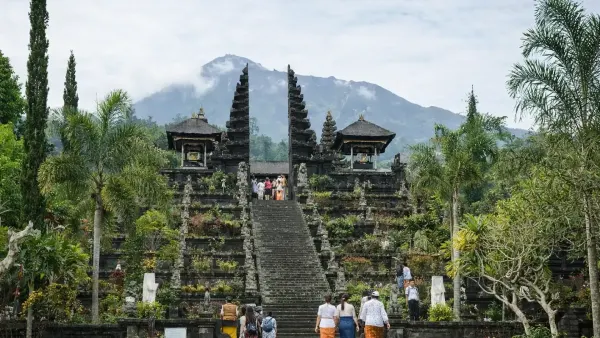
In Balinese Hindu mythology, Basuki is also the name of the primordial cosmic serpent who guards the watery foundations of the earth. Over centuries of linguistic evolution in the Balinese tongue, the sacred name Basuki softened into Besakih. The exact circular knoll where Markandeya buried the Pancha Dhatu became the inner sanctum of Pura Basukian, which still stands proudly today directly below the main stairway of Pura Penataran Agung.
The philosophical legacy of Markandeya’s expedition extends far beyond Besakih. It introduced the foundational concept of the Banjar—the democratic village cooperative hamlet that remains the building block of Balinese civil society. By distributing cleared agricultural land equally among his disciples without caste privilege, Markandeya established the egalitarian communal ethos that still governs daily life in Balinese customary villages today.
5. Archaeological Remains of the Markandeya Era on Mount Agung
Modern archaeological excavations conducted by the Balai Pelestarian Kebudayaan (BPK) confirmed Markandeya’s historical footprint. Beneath Pura Basukian, archaeologists uncovered circular stone menhirs, flat stone offering platforms, and terracotta pottery fragments dating to the Central Javanese period (8th to 9th century CE).
To this day, every time a new Balinese temple is built anywhere on the island—or even in foreign Balinese Hindu diaspora communities—the foundation ceremony begins by burying a miniature set of Pancha Dhatu, faithfully replicating the exact ritual Rsi Markandeya performed on the slopes of Mount Agung over 1,200 years ago.
Visiting Pura Basukian today offers an intimate historical counterpoint to the massive, multi-tiered pagodas of Penataran Agung. Tucked beneath mossy banyan branches, this quiet stone sanctuary preserves the primordial spark that transformed an untamed volcanic wilderness into the spiritual mother of an entire civilization.
6. Verified Sources & Scholarly References
- Dinas Kebudayaan Provinsi Bali: Koleksi dan Transkripsi Lontar Markandeya Purana (Denpasar: UPT Dokbud).
- Goris, Roelof: Prasasti Bali: Inscripties Vóór Kertanegara (N.V. Masa Baru, Bandung).
- Balai Pelestarian Kebudayaan Wilayah XV: Kajian Arkeologis Punden Berundak dan Menhir di Kompleks Pura Besakih (2020).
- Stuart-Fox, David J.: Pura Besakih: Temple, Religion and Society in Bali (KITLV Press).
- Pemerintah Provinsi Bali — Official Cultural & Environmental Preservation Portal (Love Bali).