Table of Contents
- 1. The Usana Bali: The Ancient Chronicle of Tampaksiring
- 2. The Hubris of King Mayadenawa: Outlawing Temple Worship
- 3. Biological Warfare in Antiquity: The Poisoned Spring of Yeh Penet
- 4. The Divine Strike: Piercing the Earth to Manifest Amritha
- 5. The Eternal Defeat: How Mayadenawa’s Fall Created Galungan
- 6. Verified Sources & Scholarly References
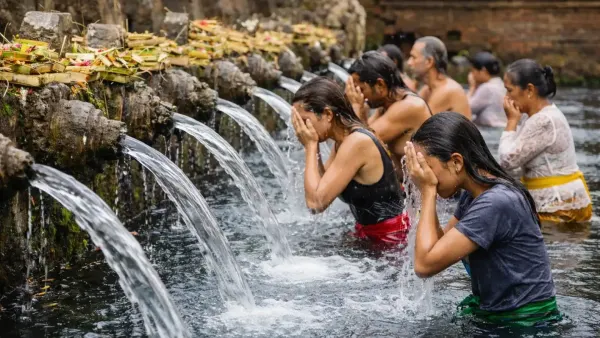
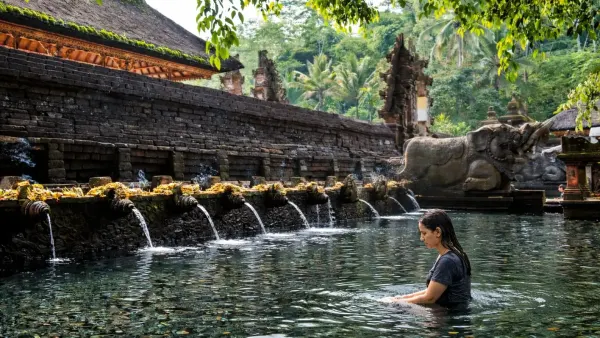
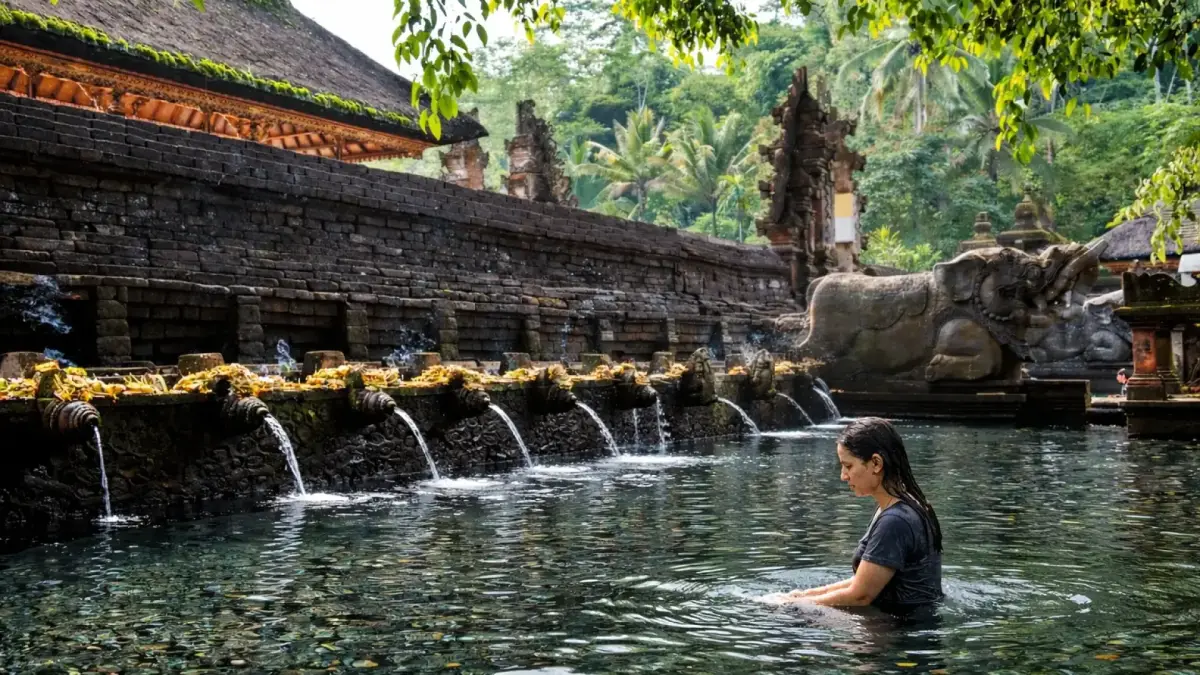
Every day, hundreds of travelers enter the crystalline purification pools of Pura Tirta Empul in Tampaksiring, washing their faces beneath carved stone spouts. Yet behind this soothing ritual lies a foundational epic of divine warfare, biological deception, and cosmic justice. According to ancient palm-leaf scriptures, Tirta Empul was not formed by peaceful monastic hands; it was birthed on a prehistoric battlefield when Lord Indra, King of the Gods, drove his celestial spear into the volcanic earth to create an elixir of immortality, resurrecting his poisoned heavenly army and destroying the demonic tyrant Mayadenawa.
When organizing cultural and spiritual journeys across Gianyar Regency, ensure full regulatory compliance by checking your travel requirements with the Bali Tourist Levy & Entry Requirements Calculator, directly supporting heritage infrastructure throughout Tampaksiring.
1. The Usana Bali: The Ancient Chronicle of Tampaksiring
The epic of Tirta Empul is recorded in the Lontar Usana Bali, an Old Javanese (Kawi) palm-leaf chronicle that blends pre-Majapahit historical memory with Vedic cosmology. Archaeological stone inscriptions discovered in the Tampaksiring river valley—notably the Prasasti Sading C dated to 962 CE during the reign of King Candrabhaya Singha Warmadewa—corroborate that the spring pool was engineered over a millennium ago, endowing the mythic chronicle with verifiable historical antiquity.
The name Tirta Empul translates literally as "Holy Water Gushing from the Earth," referencing the perpetual subterranean boiling action visible in the central courtyard pond where black sand dances in clean crystalline artesian water. For Balinese scholars, the texts are not merely fantastical allegories; they document real political crises in ancient Bali, specifically the struggle between orthodox Vedic Shaivism and indigenous antinomian cults that rejected communal temple worship and irrigation sharing.
The battle of Mayadenawa thus operates on multiple interpretive layers: as a historical memory of religious unification under the early Warmadewa dynasty, as a seasonal agricultural myth reflecting the renewal of water following drought, and as an esoteric yogic manual detailing the purification of the human energy channels (Nadi) through sacred water meditation.
2. The Hubris of King Mayadenawa: Outlawing Temple Worship
According to the Usana Bali, centuries before the arrival of the Majapahit Brahmin reformers, Bali was ruled from Bedahulu by King Mayadenawa. Endowed with supernatural powers (Siddhi) through intense ascetic austerities, Mayadenawa possessed shape-shifting mastery, capable of transforming into birds, trees, animals, and stones.
The Spiritual Catastrophe
Corrupted by unbridled pride, Mayadenawa declared himself the supreme God of the universe. He banned all offerings to the ancestral deities, destroyed village shrines, outlawed the cultivation of sacred rice offerings, and executed priests who refused to bow before his throne. The celestial balance broke: torrential droughts struck the island, harvests rotted on the stalk, and famine threatened to wipe out the Balinese people.
Desperate, the high priests retreated into the mountain caves of Mount Agung to petition the heavens. Hearing their cries, Lord Indra descended from Swarga Loka leading a legion of celestial deities (Bhatara) to restore cosmic equilibrium.
3. Biological Warfare in Antiquity: The Poisoned Spring of Yeh Penet
Indra’s heavenly warriors marched down the central volcanic spine of Bali, pushing Mayadenawa’s forces northward into the dense forests of the Pakerisan river valley. Realizing he could not defeat Indra in direct open combat, Mayadenawa resorted to treacherous asymmetrical warfare.
Under the cover of darkness, while Indra’s troops slept encamped along the valley, Mayadenawa crept across the campsite on the sides of his feet so as to leave no footprints—giving the region its permanent historical name: Tampaksiring (from Tampak = footstep, and Siring = slanted or tilted). He secretly diverted a subterranean stream, contaminating it with a lethal botanical poison. When Indra’s soldiers awoke and drank from the spring, known as Yeh Penet, hundreds collapsed in agonizing convulsions, their bodies paralyzed on the verge of death.
4. The Divine Strike: Piercing the Earth to Manifest Amritha
Finding his army poisoned, Lord Indra knelt in deep concentration, holding his sacred celestial lance (Duhata / Trisula). Reciting ancient Vedic mantras of creation, Indra struck his spear deep into the volcanic ground.
Instantly, the earth fractured. A massive geyser of sparkling, uncorrupted water erupted from the fracture with thunderous force. This was the Tirtha Amritha—the mythological nectar of immortality. Indra carried the bubbling spring water across his fallen soldiers, washing their lips and eyes. As the water touched their skin, the poison dissolved; life returned to their limbs, and the celestial army arose revitalized, stronger than before.
| Mythological Phase | Geographical Location in Tampaksiring | Modern Theological Reality |
|---|---|---|
| The Tilted Night Walk | Tampaksiring Village Corridor | Etymological origin of the district; symbol of deceitful ego. |
| The Speared Spring | Central Inner Basin (Pura Tirta Empul) | The 30 purification spouts channeling Amritha for pilgrim cleansing. |
| The Final Transformation | Tukad Pakerisan River Chasm | The defeat of ego; where Mayadenawa dissolved into stone. |
5. The Eternal Defeat: How Mayadenawa’s Fall Created Galungan
Revived by the sacred spring, Indra pursued Mayadenawa down the Pakerisan gorge. The desperate tyrant transformed himself sequentially into a giant bird (Manuk Raya), a coconut palm, and finally a massive boulder. Seeing through every illusion, Indra pierced the stone with a divine arrow, slaying the tyrant and liberating the island from spiritual darkness.
The day of Mayadenawa’s defeat is celebrated across Bali as Hari Raya Galungan—the supreme Balinese festival celebrating the eternal victory of Dharma (righteous truth and cosmic order) over Adharma (chaos, tyranny, and ego). When pilgrims bathe at Tirta Empul today, they are not simply cooling off in fresh water; they are reenacting Lord Indra’s cosmic victory, washing away their own inner Mayadenawa—their ego, greed, and spiritual illusions—in the eternal spring of Amritha.
6. Verified Sources & Scholarly References
- Dinas Kebudayaan Provinsi Bali: Transkripsi dan Terjemahan Lontar Usana Bali (Denpasar: UPT Dokbud).
- Balai Pelestarian Cagar Budaya (BPCB) Bali: Kajian Arkeologis Epigrafi Prasasti Sading C dan Sejarah Tirta Empul (2019).
- Goris, Roelof: Sedjarah Bali Kuno (Percetakan Bali, Singaraja).
- Vickers, Adrian: Bali: A Paradise Created (Tuttle Publishing).
- Universitas Hindu Indonesia (UNHI): Mitos Mayadenawa dalam Perspektif Teologi Hindu dan Filosofi Galungan.
- Pemerintah Provinsi Bali — Official Cultural & Environmental Preservation Portal (Love Bali).