Table of Contents
- 1. The Only Post-Colonial Palace: Sukarno’s Architectural Vision
- 2. Tropical Modernism Meets Balinese Vernacular Architecture
- 3. Jembatan Persahabatan: The 40-Meter Suspension Walkway
- 4. Cold War Diplomacy: World Leaders at the Edge of the Holy Spring
- 5. Contemporary Visiting Protocols and Conservation
- 6. Verified Sources & Scholarly References
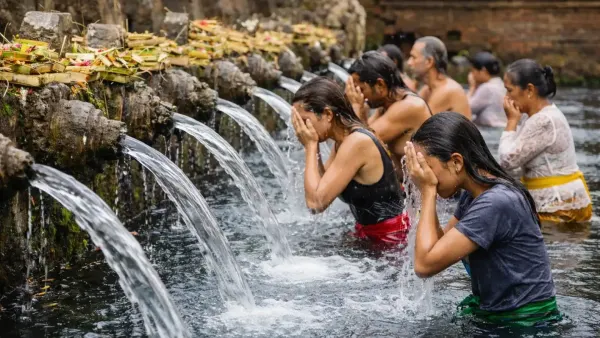
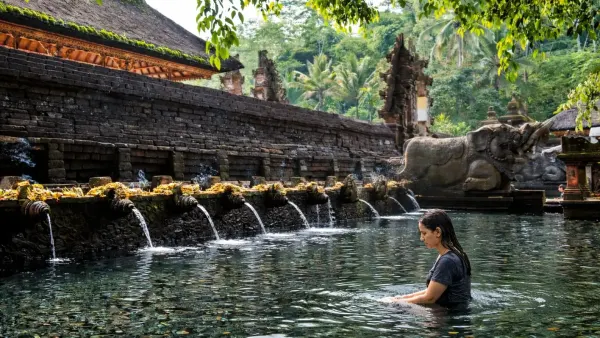
Stand in the outer courtyard of Pura Tirta Empul and look upward toward the lush green hillside to the west. Looming silently above the sacred spring basin, perched atop a manicured bluff, rests an elegant modernist complex of white walls, flat overhanging eaves, and expansive glass verandas. This is Istana Tampaksiring (Tampaksiring Presidential Palace). Built between 1957 and 1963, it holds a unique place in Indonesian history as the only presidential palace commissioned, designed, and constructed after the nation’s independence from Dutch colonial rule—conceived personally by Indonesia’s founding father, President Sukarno.
When organizing historical journeys across Gianyar, calculate all required travel levy contributions and municipal visitor fees via the Bali Tourist Levy & Entry Requirements Calculator, supporting heritage preservation across central Bali.
1. The Only Post-Colonial Palace: Sukarno’s Architectural Vision
All other official Indonesian presidential palaces—Istana Merdeka and Istana Negara in Jakarta, Istana Bogor, and Istana Cipanas in West Java—were originally constructed by the Dutch East India Company (VOC) or the Dutch colonial administration as residences for Governors-General. Tampaksiring stands alone as a purely post-colonial monument.
President Sukarno, whose mother Ida Ayu Nyoman Rai was a Balinese aristocrat from Buleleng, held a profound personal and spiritual connection to the Island of the Gods. In 1954, Sukarno conceived a dedicated palace complex where world leaders, international monarchs, and state guests could experience Indonesia’s ancient living cultural soul outside the formal political climate of Jakarta.
2. Tropical Modernism Meets Balinese Vernacular Architecture
Designed by prominent Indonesian architect R.M. Soedarsono under Sukarno’s direct artistic supervision, Istana Tampaksiring is celebrated by architectural historians as a masterpiece of Mid-Century Tropical Modernism.
| Palace Pavilion | Architectural Purpose | Design Characteristics |
|---|---|---|
| Gedung Merdeka (Main Hall) | Presidential private quarters & bilateral summit salon | Expansive cantilevers, teak paneling, floor-to-ceiling glass gazing over Tirta Empul. |
| Gedung Yudhistira | State guest villa for visiting heads of state | Balinese Paras stone plinths combined with international modernist minimalism. |
| Gedung Bima | Diplomatic banquet hall & cultural performance stage | Traditional open Wantilan pavilion structure with vaulted tropical timber ceilings. |
Rather than dominating the landscape, the palace buildings follow the natural contour of the hill, stepping gently down toward the Pakerisan river valley. Sukarno mandated that the rooflines remain lower than the crowns of the sacred banyan trees, ensuring modern state power yielded aesthetic deference to the ancient temple below.
The interior design showcases fine Indonesian craftsmanship: polished Javanese teak floors, hand-loomed Balinese songket upholstery, and an exceptional private art collection featuring original oil paintings by Indonesian masters like Affandi, Basoeki Abdullah, and Hendra Gunawan, alongside works by foreign resident artists like Antonio Blanco and Walter Spies. The palace essentially served as a living museum of post-independence Indonesian cultural diplomacy.
3. Jembatan Persahabatan: The 40-Meter Suspension Walkway
One of the most striking engineering features of the palace grounds is the Jembatan Persahabatan (Bridge of Friendship). This 40-meter suspension walkway spans the deep green river ravine between Gedung Merdeka and Gedung Yudhistira.
The View of the Gods
Standing on the center of the wooden bridge suspended thirty meters above the Pakerisan stream, world leaders could look down through the jungle canopy directly into the bubbling turquoise waters of Tirta Empul. Sukarno frequently walked foreign dignitaries across this bridge at dawn, explaining that true governance requires maintaining connection with the pure springs of spiritual heritage.
4. Cold War Diplomacy: World Leaders at the Edge of the Holy Spring
During the height of the Cold War and the Non-Aligned Movement in the late 1950s and 1960s, Istana Tampaksiring hosted an astonishing array of global statesmen:
- Nikita Khrushchev (Premier of the Soviet Union): Stayed at the palace in February 1960, enchanted by Balinese legong dances staged in the inner gardens.
- Marshal Josip Broz Tito (President of Yugoslavia): Held bilateral strategy meetings with Sukarno formulating the foundational charter of the Non-Aligned Movement.
- Ho Chi Minh (President of North Vietnam): Conferred with Sukarno on regional anti-colonial solidarity.
- Subsequent State Guests: In later decades, the palace hosted Indian Prime Minister Indira Gandhi, Queen Elizabeth II, Japanese Emperor Akihito, and King Salman of Saudi Arabia.
Diplomatic memoirs from the era reveal that Sukarno used the natural tranquility and sacred acoustics of Tirta Empul as an active diplomatic instrument. When negotiations over maritime boundaries or international aid became tense in Jakarta, Sukarno relocated delegations to Tampaksiring. Walking through the fragrant gardens of frangipani and night-blooming jasmine while hearing temple gamelan music drifting up from the valley below had an undeniable pacifying effect on foreign envoys.
5. Contemporary Visiting Protocols and Conservation
Istana Tampaksiring remains an active official state residence under the administration of the Secretariat of the President (Kemensetneg). While security regulations restrict casual access, travelers can apply in advance for guided heritage tours through official state channels:
- Advance Written Permit: Applications must be submitted via the official Presidential Palace portal (Setneg) at least seven business days prior to your visit.
- Dress Code: Formal attire is mandatory (collared shirts, long trousers or knee-length dresses, closed shoes; shorts and flip-flops are strictly barred).
- Photography Restrictions: Photography is permitted in the manicured botanical gardens and suspension bridge, but photography inside the presidential living chambers remains prohibited.
- Security Screening: Visitors must present original passports or Indonesian national identity cards (KTP) at the military gatehouse (Paspampres post) before boarding the internal electric shuttle cart.
For travelers interested in 20th-century geopolitical history and architectural preservation, a permitted visit to Istana Tampaksiring offers an extraordinary counterpart to ancient Balinese temples. It demonstrates how mid-century Indonesian leaders sought to project national dignity on the international stage while remaining anchored in ancestral soil and spiritual reverence.
6. Verified Sources & Scholarly References
- Kementerian Sekretariat Negara Republik Indonesia: Sejarah dan Arsitektur Istana Kepresidenan Tampaksiring Bali (Jakarta, 2020).
- Sukarno: An Autobiography as Told to Cindy Adams (The Bobbs-Merrill Company, Indianapolis, 1965).
- Kusno, Abidin: Behind the Postcolonial: Architecture, Urban Space and Political Cultures in Indonesia (Routledge).
- Balai Pelestarian Kebudayaan Wilayah XV: Kawasan Cagar Budaya Pakerisan dan Integrasi Istana Tampaksiring (2022).
- Pemerintah Provinsi Bali — Official Cultural & Environmental Preservation Portal (Love Bali).