Table of Contents
- 1. The Inner Pool: The Phenomenon of the "Boiling" Sand
- 2. The Batur-Kintamani Recharge Zone: A Subterranean Journey
- 3. Fluidized Sand Beds: Nature’s High-Efficiency Water Filter
- 4. 10th-Century Hydraulic Architecture: King Candrabhaya’s Masterwork
- 5. Water Quality and Contemporary Agricultural Subak Flow
- 6. Verified Sources & Scholarly References
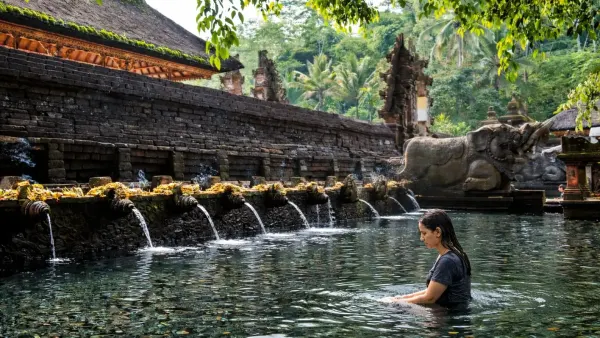
Behind the bustling bathing pools of Pura Tirta Empul, separated by a low carved balustrade, rests a serene rectangular basin enclosed by towering ancient stone shrines. Peer down through its crystal-clear emerald surface and you will witness an extraordinary natural spectacle: dozens of vents on the pool floor where fine, jet-black volcanic sand churns, boils, and billows in perpetual motion as water surges upward from the Earth's mantle. This is the hydrogeological engine of Tirta Empul—a textbook natural artesian spring system engineered over a thousand years ago into a sacred hydraulic masterpiece.
When organizing cultural and environmental excursions across Gianyar Regency, calculate mandatory provincial contributions in advance with the official Bali Tourist Levy & Entry Requirements Calculator, supporting conservation programs managed across Tampaksiring.
1. The Inner Pool: The Phenomenon of the "Boiling" Sand
The central holy basin (Kolam Mata Air Utama) measures approximately 20 meters by 15 meters, with a depth ranging from 1.5 to 2.2 meters. The water is so transparent that sunlight creates rippling golden caustics on the black volcanic floor. What immediately captivates observers is that the water does not flow into the pool from a river or pipe; it surges directly from the underlying bedrock under natural hydrostatic pressure.
This upward hydraulic velocity creates localized fluidized sand beds. Grains of volcanic quartz, augite, and magnetite are buoyed by rising groundwater, suspended in constant turbulent motion without settling or washing away. The effect resembles a boiling cauldron, yet the water is refreshingly cool, maintaining a perennially stable temperature between 21°C and 23°C throughout both the wet and dry seasons.
2. The Batur-Kintamani Recharge Zone: A Subterranean Journey
Where does this endless deluge of pure water originate? Hydrogeological tracer studies conducted by researchers from Udayana University and the Center for Groundwater Resources (PATG) reveal that the recharge zone lies over twenty kilometers to the north, on the elevated slopes of the Mount Batur caldera in Kintamani.
The Subterranean Transit
Monsoonal rains falling over Kintamani’s porous volcanic ash beds percolate deep into fractured basaltic and andesitic lava strata. Trapped between impermeable tuffaceous clay layers (a classic confined artesian aquifer), the water flows southward down the island’s gradient under immense gravitational head pressure. Radio-isotope carbon dating of the spring discharge indicates that the water emerging from Tirta Empul took between 12 and 18 years to filter through the volcanic crust.
This prolonged underground residence time accounts for the water's unique chemical fingerprint. As rainwater migrates through hot and cold volcanic strata, it dissolves rich concentrations of silica (SiO2), potassium, calcium, and bicarbonate ions while maintaining near-zero nitrate and organic carbon levels. When it finally breaches the surface at Tampaksiring, it emerges not merely as filtered surface runoff, but as pristine mineralized artesian water charged with the geological memory of the volcanic highlands.
3. Fluidized Sand Beds: Nature’s High-Efficiency Water Filter
The pristine clarity of Tirta Empul is the direct result of continuous multi-stage natural mechanical filtration:
| Filtration Stage | Geological Medium | Primary Hydrochemical Function |
|---|---|---|
| Primary Percolation | Fractured basaltic lava flows (Mt. Batur) | Coarse mechanical particle filtration; mineral enrichment (silica, magnesium, calcium). |
| Subsurface Residence | Deep pyroclastic tuff formations | Natural biological pathogen neutralization; zero organic contaminants survive deep transit. |
| Discharge Fluidization | Basal black volcanic sand beds (Tampaksiring) | Fluidized bed filtration preventing fine sediment backflow; maintains optical crystal clarity. |
4. 10th-Century Hydraulic Architecture: King Candrabhaya’s Masterwork
The physical structure of Tirta Empul is not an accidental pond, but an ancient hydraulic monument. Inscribed stone tablets confirm that in 962 CE, King Candrabhaya Singha Warmadewa formalized the natural spring into an elaborate architectural sanctuary.
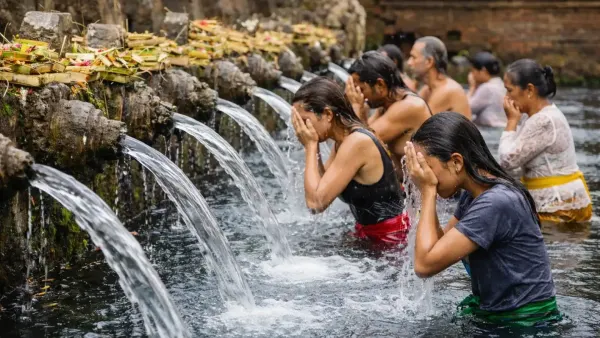
Ancient Warmadewa hydraulic engineers understood hydrostatic physics. They designed a series of gravity-fed weir overflow gates (Tetuad) that maintain an unchanging water level in the main spring basin regardless of seasonal rainfall variations. Water from the inner basin overflows silently through subterranean conduits into the adjoining purification courtyards, where it is distributed through thirty carved stone spouts (Pancuran) before discharging into the sacred Pakerisan River.
The stone masonry of the inner basin employs interlocking volcanic andesite blocks dry-stacked without mortar, allowing subterranean groundwater pressure to relieve naturally through joints without causing structural blowouts or wall buckling. This ancient seismic and hydraulic resilience explains why the temple basin has survived numerous major earthquakes—including the catastrophic 1917 Geijer earthquake that leveled thousands of structures across southern Bali—with its foundational geometry completely intact.
5. Water Quality and Contemporary Agricultural Subak Flow
Beyond its spiritual role, Tirta Empul is the primary water lifeline for thousands of hectares of terraced rice paddies in Gianyar. After flowing through the public purification pools, the water enters the Pakerisan river irrigation canal network, feeding downstream Subak agricultural cooperatives.
Laboratory analyses conducted regularly by the Gianyar Environmental Health Agency confirm that the raw spring water entering the pool contains exceptionally low turbidity (< 0.5 NTU), neutral pH (7.2 – 7.4), and zero heavy metals, making it among the purest natural groundwater sources in the Indonesian archipelago. Preserving the subterranean recharge forests in Kintamani remains essential to ensuring this sacred fountain flows unimpeded for the next thousand years.
The temple also functions as a Pura Ulun Swi (headwater temple) within the Subak federation. Delegations of farmers from dozens of surrounding hamlets travel to Tirta Empul prior to each seasonal planting cycle to collect consecrated water (Tirta Panglukatan) in bamboo tubes, which they disperse across their headgates to protect young rice seedlings from insect blights and fungal pathogens, illustrating how hydrology, agriculture, and religious faith remain completely unified in Balinese daily life.
6. Verified Sources & Scholarly References
- Pusat Air Tanah dan Geologi Tata Lingkungan (PATG), Kementerian ESDM: Karakteristik Hidrogeologi Cekungan Air Tanah Tampaksiring-Ubud (Bandung, 2021).
- Fakultas Pertanian Universitas Udayana: Kualitas Air Mata Air Alami Pura Tirta Empul dan Dampaknya Terhadap Sistem Subak Pakerisan (2022).
- Balai Pelestarian Kebudayaan (BPK) Wilayah XV: Arsitektur Hidraulika Kuno Kompleks Percandian Lembah Tukad Pakerisan.
- Kempers, A. J. Bernet: Monumental Bali: Introduction to Balinese Archaeology (Periplus Editions).