Table of Contents
- 1. The Concept of Moksha: The Great Brahmin’s Final Departure
- 2. The Southwestern Axis: Rudra and the Realm of Cosmic Dissolution
- 3. Anatomy of the Meru: The 3-Tiered Black Sugar-Palm Roof
- 4. Candi Kurung and the Monolithic Coral Gateway Carvings
- 5. The Piodalan of Anggara Kasih Medangsia: Living Continuity
- 6. Verified Sources & Scholarly References
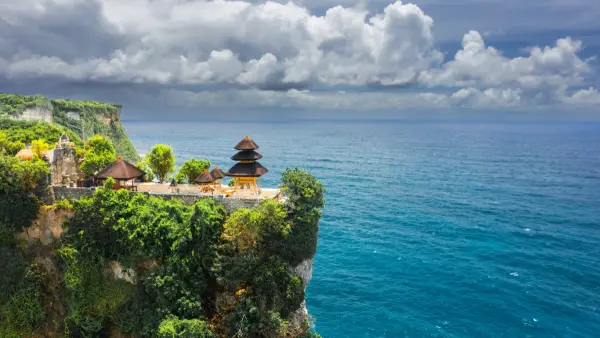
At the southernmost precipice of Bali, where seventy meters of vertical limestone drop sheer into the churning Indian Ocean, stands an understated yet intensely sacred three-tiered pagoda roofed with black sugar-palm fiber. This is the inner sanctum of Pura Luhur Uluwatu. In the spiritual geography of Balinese Hinduism, this headland is venerated as the supreme threshold between mortality and eternity. It was here, in the late sixteenth century, that Bali’s most celebrated religious reformer, the high priest Dang Hyang Nirartha (revered here as Dang Hyang Dwijendra), achieved Moksha—the total liberation of the soul from the cycle of rebirth, dissolving bodily form directly into cosmic light.
Travelers seeking an authentic spiritual understanding of Bali should calculate and settle their mandatory conservation dues via the Bali Tourist Levy & Entry Requirements Calculator before visiting sacred sanctuaries in Badung Regency.
1. The Concept of Moksha: The Great Brahmin’s Final Departure
In Balinese Hindu philosophy, the four supreme goals of human existence are defined as Catur Purusa Artha: Dharma (righteous living and spiritual duty), Artha (material wealth used for virtue), Kama (sensory enjoyment and worldly fulfillment), and the ultimate summit, Moksha (liberation from the eternal cycle of reincarnation, Samsara).
According to the classical lontar manuscript Dwijendra Tattwa, after establishing sea temples along Bali’s coasts and completing his doctrinal reforms at the Gelgel royal court, Dang Hyang Dwijendra felt his earthly mission concluding. He made a final pilgrimage to the lonely, limestone bluffs of Pecatu, then known as Ulu Atu ("The Land’s End on the Rock Peak").
The Miraculous Dissolution (Ngeluhur)
Sitting in deep samadhi meditation on the clifftop facing the setting sun over the ocean, Dwijendra focused the seven mystical centers of his subtle body (Chakras). Classical accounts narrate that a brilliant column of golden light descended from the heavens, engulfing the sage. His physical form dematerialized completely without leaving behind flesh, bone, or ash—an event known reverently as Moksha / Ngeluhur. Because he achieved ascension here, the sanctuary was bestowed the supreme prefix Luhur (Exalted/Heavenly), becoming Pura Luhur Uluwatu.
2. The Southwestern Axis: Rudra and the Realm of Cosmic Dissolution
Uluwatu’s clifftop location is not an aesthetic coincidence; it is rooted in strict directional cosmology known as the Dewata Nawa Sanga (the Nine Divine Guardians of Space). In this metaphysical mandala:
| Cosmic Direction | Presiding Manifestation | Color & Weapon Attribute | Primary Sanctuary |
|---|---|---|---|
| Southwest (Krobokan / Nariti) | Bhatara Rudra | Orange / Flame; Moksala / Club | Pura Luhur Uluwatu |
| Northeast (Kaja Kangin) | Bhatara Sambhu | Blue-Grey; Trisula (Trident) | Pura Besakih Axis |
| North (Kaja) | Bhatara Wisnu | Black; Cakra Disc | Pura Ulun Danu Batur |
Lord Rudra is the fierce aspect of Lord Shiva responsible for the dissolution of the universe and the destruction of earthly illusion. The southwestern cliff edge represents the ultimate portal for dissolution: where solid land terminates abruptly and the infinite watery void of the ocean begins. By passing through this southwestern gate, Dwijendra returned directly to the primordial source of cosmic consciousness.
3. Anatomy of the Meru: The 3-Tiered Black Sugar-Palm Roof
Inside the restricted inner courtyard (Jeroan) of Uluwatu stands the architectural focal point: a three-tiered Pelinggih Meru Tumpang Tiga. Unlike ordinary shrines roofed with drying thatch (alang-alang), the Meru of Uluwatu is thatched exclusively with dense, velvety black fiber harvested from the trunk of the sugar-palm tree (Arenga pinnata), known in Balinese as Ijuk.
The selection of black ijuk carries profound symbolic weight:
- Elemental Longevity: High-grade ijuk fiber is virtually impervious to maritime salt-air decay and insect attacks, capable of withstanding the punishing tropical gales of the southern ocean for over thirty years before re-thatching is required.
- Cosmic Darkness: Black is the symbolic color of depth, the formless cosmic abyss, and the Supreme Mystery.
- Three Tiers of Existence: The three receding roof tiers (Tumpang Tiga) represent the Tri Loka: Bhur Loka (the underworld and realm of physical senses), Bhuwah Loka (the intermediate realm of purification), and Swah Loka (the highest heavenly realm of enlightened spirits).
4. Candi Kurung and the Monolithic Coral Gateway Carvings
The gateway separating the outer courtyard (Jaba Tengah) from the inner courtyard (Jeroan) is one of the oldest preserved stone portals in southern Bali. Known as a Kori Agung or Candi Kurung, it is constructed entirely from dense, weathered white marine limestone coral blocks cut by hand centuries ago.
Surmounting the portal is an imposing relief carving of Bhoma, the monstrous terrestrial son of the Earth Goddess Pertiwi and Lord Wisnu. With wide, staring eyes, fanged tusks, and clawed hands outstretched to either side, Bhoma’s visage serves as an apotropaic guardian, magically stripping impure thoughts, earthly ego, and malicious spirits from anyone passing beneath the archway.
Flanking the stairs are two winged guardians resembling Garuda, carved in an archaic East Javanese style that closely links Uluwatu’s stone masonry directly to fourteenth-century Majapahit court art.
5. The Piodalan of Anggara Kasih Medangsia: Living Continuity
The anniversary of the temple (Piodalan) is commemorated every 210 days on Anggara Kasih Medangsia (Tuesday of the week Medangsia in the Balinese Pawukon cycle). On this day, the royal lineage of Puri Kesiman (Denpasar), who serve as hereditary protectors (Pengempon) of Uluwatu, leads hundreds of village devotees in a solemn coastal pilgrimage.
As dusk falls and ocean spray rises into the cooling air, the priests chant ancient Sanskrit stanzas (Mantra Weda), their voices blending with the rhythmic thrum of the sea. For travelers who look beyond the superficial spectacle of tourist crowds, Uluwatu remains an active, pulsing altar to humanity’s yearning for the infinite.
6. Verified Sources & Scholarly References
- Kempers, A. J. Bernet: Monumental Bali: Introduction to Balinese Archaeology & Guide to the Monuments (Periplus Editions).
- Balai Pelestarian Kebudayaan (BPK) Wilayah XV: Dokumentasi Arsitektur Candi Bentar dan Kori Agung Pura Luhur Uluwatu (2021).
- Universitas Hindu Indonesia (UNHI): Konsepsi Ketuhanan dan Ajaran Moksha dalam Lontar Dwijendra Tattwa (Denpasar: Widya Dharma Press).
- Puri Kesiman Archives: Babad Puri Ageng Kesiman dan Sejarah Pengempon Pura Luhur Uluwatu (Denpasar).
- Pemerintah Provinsi Bali — Official Cultural & Environmental Preservation Portal (Love Bali).