Table of Contents
- 1. The Mountain Canopy: Ecological Buffer of Eastern Bali
- 2. Awig-Awig Hutan Adat: Customary Forestry Statutes
- 3. Tri Mandala Zonation: Utamaning Mandala on the Volcanic Rim
- 4. Montane Ecology: High-Altitude Pine, Cemara, and Edelweiss
- 5. Climbing Protocols: Respecting Sacred Boundaries on Mount Agung
- 6. Verified Sources & Scholarly References
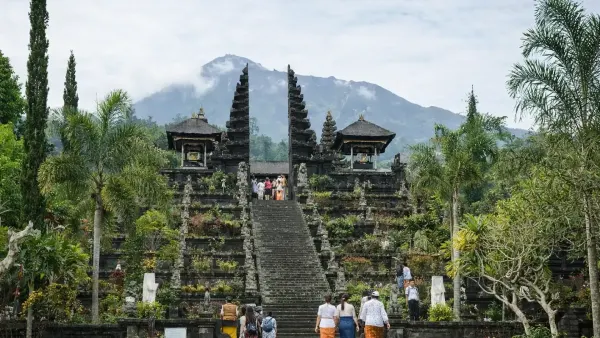
Ascend past the highest stone shrine of Pura Besakih (Pura Pengubengan) and the manicured stone plazas give way to dense, mist-shrouded montane cloud forest climbing toward the crater rim of Mount Agung. While many external trekking agencies market Mount Agung simply as an adrenaline-fueled volcano hike, this wilderness is legally protected under centuries-old customary statutes known as Awig-Awig Hutan Adat. Maintained by the traditional customary village of Desa Adat Besakih, these indigenous forestry laws govern every tree, spring, and footpath, providing an extraordinary shield against environmental degradation.
When organizing high-altitude wilderness treks across Karangasem, confirm your required municipal visitor contributions and environmental dues via the official Bali Tourist Levy & Entry Requirements Calculator.
1. The Mountain Canopy: Ecological Buffer of Eastern Bali
Covering over twelve thousand hectares across the upper caldera flanks of Mount Agung, the customary forest represents the primary water catchment basin for all of Karangasem, Klungkung, and eastern Bangli regencies. The sponge-like mossy volcanic topsoil captures torrential monsoonal clouds, slowly releasing filtered groundwater through deep subterranean fissures that feed hundreds of lowland irrigation springs months after the rains cease.
Deforestation on these steep slopes would trigger catastrophic wet-season landslides (Longsor) and lahars that could level villages and destroy downstream temple infrastructure. Recognizing this vital ecological truth centuries before modern environmental science, Balinese customary elders codified forest protection directly into religious jurisprudence.
The forest also plays an indispensable role in climate moderation. By transpiring millions of liters of moisture daily into the mountain air, the dense canopy creates an enduring highland cloud envelope that buffers eastern Bali against the severe arid droughts associated with the southeast Australian monsoon winds. Preserving these ancient montane canopies remains essential for safeguarding agricultural food security throughout the eastern regencies of Bali.
2. Awig-Awig Hutan Adat: Customary Forestry Statutes
The indigenous statutes governing the mountain are codified in the Awig-Awig Desa Adat Besakih. Unlike national forestry laws that are often difficult for state rangers to enforce across rugged terrain, customary law carries absolute social and spiritual authority:
| Prohibited Action | Customary Statute (Awig-Awig) | Sanction & Penalty Enforced |
|---|---|---|
| Illegal Timber Felling | Strict ban on felling sacred montane timber (Cemara, Majegau). | Heavy monetary fine + compulsory replanting of 10 native saplings + Prayascitta purification rites. |
| Commercial Wildlife Poaching | Zero hunting of birds, barking deer (Kijang), or civets. | Confiscation of equipment + public reprimand before village assembly (Sangkep Desa). |
| Littering & Waste Dumping | Mandatory pack-in, pack-out rule for all trekking operators. | Immediate revocation of trekking guide license in Besakih district. |
The Spiritual Fear of Pastu
The ultimate deterrent in Awig-Awig is the concept of Pastu (customary spiritual curse). Balinese villagers firmly believe that anyone who secretly damages the sacred forest of Mount Agung without being caught by human wardens will incur direct karmic retribution from the mountain deities—manifesting as sudden illness, misfortune, or spiritual madness.
3. Tri Mandala Zonation: Utamaning Mandala on the Volcanic Rim
The spatial management of Mount Agung is structured according to the classical Tri Mandala doctrine:
- Nistaning Mandala (Outer Realm): Lower foothills below 900 meters elevation; designated for sustainable agroforestry, fruit orchards, and traditional dryland farming.
- Madyaning Mandala (Middle Realm): The zone between 900 and 2,200 meters containing Pura Besakih and the high-altitude cloud forest; strictly protected for ritual water collection, controlled livestock forage, and managed eco-trekking.
- Utamaning Mandala (Inner/Highest Sanctum): The volcanic summit ridge and active crater rim above 2,200 meters; classified as purely consecrated space where no permanent human structures or commercial activities of any kind are permitted.
4. Montane Ecology: High-Altitude Pine, Cemara, and Edelweiss
The high-altitude forest above Besakih represents a distinct biogeographical ecosystem adapted to volcanic sulfur gases and thin mountain air:
- Casuarina junghuhniana (Cemara Gunung): High-altitude mountain pines with fine needle-like foliage that efficiently strip water droplets from passing cloud banks, contributing significantly to groundwater recharge.
- Anaphalis javanica (Javanese Edelweiss / Bunga Abadi): Growing along the rocky scree slopes above the tree line; revered by the Balinese as the "Eternal Flower," harvested strictly under priestly supervision for sacred temple offerings.
- Barking Deer (Muntiacus muntjak): Small, elusive native deer that roam the upper gullies, protected by village taboo from human hunting.
- Volcanic Ferns and Lichens: Primitive flora colonizing solidified basalt lava flows, breaking rock down into nutrient-rich volcanic soil for future forest succession.
The botanical division of Udayana University monitors these high-altitude populations, noting that the strict traditional sanctions of Awig-Awig have prevented illegal timber harvesting far more effectively than formal state nature reserves elsewhere in Indonesia.
5. Climbing Protocols: Respecting Sacred Boundaries on Mount Agung
For adventurous travelers planning to summit Mount Agung via the Besakih trail, strict cultural compliance is enforced at the trailhead gatehouse:
- Mandatory Local Customary Guide: Solo unguided climbing is strictly illegal. Hikers must be accompanied by a certified customary guide from the Besakih Guides Association (Persatuan Pemandu Wisata Desa Besakih).
- Trailhead Blessing (Mapepada): Before beginning the ascent at 23:00 PM, every climber must pause at Pura Pengubengan to present a Canang Sari offering and receive holy water from the resident Pemangku, asking the volcano for permission and safe passage.
- Seasonal Closures: The trail is completely closed to all hiking during major religious celebrations (including Bhatara Turun Kabeh and Galungan) to preserve the mountain’s spiritual tranquility.
- Respecting Peak Sanctity: At the 3,142-meter summit crater, climbers must refrain from shouting, playing music, or consuming beef products, which violate Balinese Hindu purity taboos.
By approaching Mount Agung not as a mountaineering conquered summit, but as an active sacred temple, travelers honor the ancient indigenous stewardship that has preserved this magnificent volcanic ecosystem for over a millennium.
6. Verified Sources & Scholarly References
- Pemerintah Desa Adat Besakih: Awig-Awig Perlindungan Hutan Adat dan Kawasan Suci Gunung Agung (2021).
- Dinas Kehutanan dan Lingkungan Hidup Provinsi Bali: Rencana Pengelolaan Kawasan Hutan Lindung Gunung Agung (2022).
- Whitten, Tony et al.: The Ecology of Java and Bali (Oxford University Press / Periplus Editions).
- Surpha, I Wayan: Eksistensi Desa Adat dan Pengelolaan Lingkungan Tradisional di Bali (Pustaka Bali Post).
- Pemerintah Provinsi Bali — Official Cultural & Environmental Preservation Portal (Love Bali).