Every year, on the eve of Nyepi, Bali explodes into sound, fire, and movement. Streets that will be completely silent the next day suddenly fill with drums, shouting, laughter, and towering demons carried high above the crowd. This is the Ogoh-Ogoh Parade Bali, a ritual night where chaos is not feared, but invited, confronted, and finally released.
As someone born and raised on this island, I can tell you that Ogoh-Ogoh night is not entertainment in the usual sense. It is collective energy given form. A moment when Bali allows itself to be loud so it can truly be quiet the next day.
The Myth Behind the Monsters: Bhuta Kala Unleashed
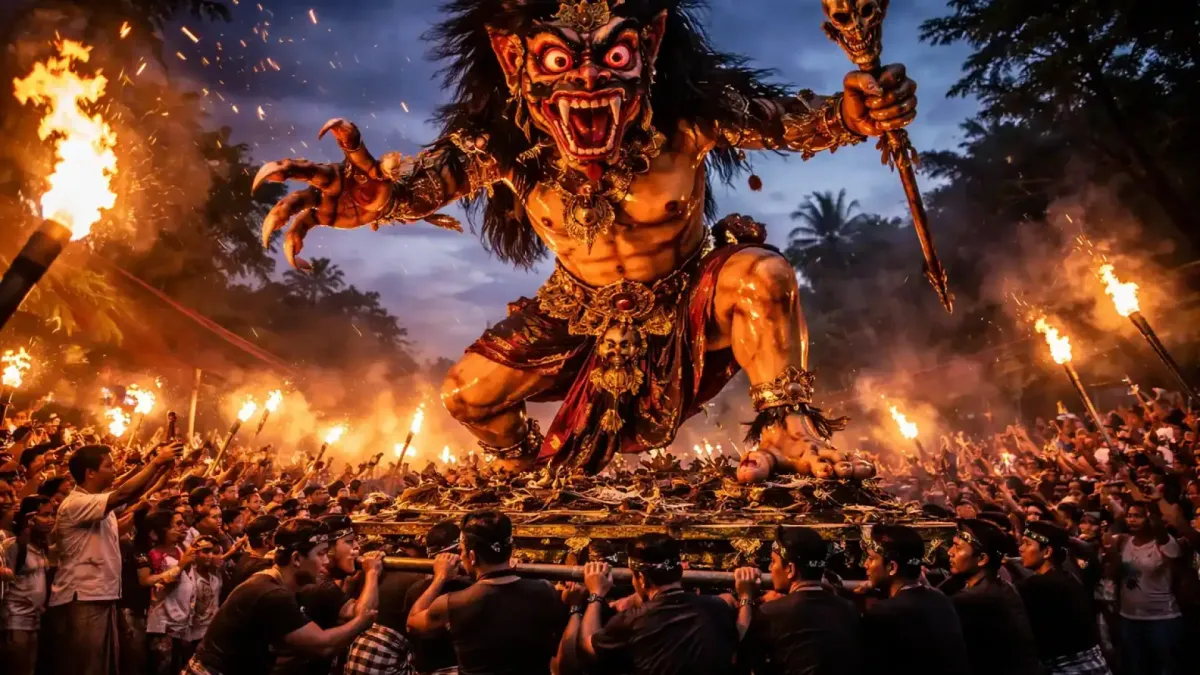
The giant figures you see are called Ogoh-Ogoh, physical representations of Bhuta Kala. In Balinese Hindu belief, Bhuta Kala embodies untamed forces of nature and human emotion. Anger, greed, arrogance, fear. Everything that disrupts balance.
Rather than denying these forces, Balinese philosophy teaches us to acknowledge them. Ogoh-Ogoh are intentionally exaggerated, grotesque, and intimidating. Bulging eyes, sharp fangs, twisted bodies. They are mirrors of excess. By parading Bhuta Kala through the streets, negative energies are drawn out, recognized, and symbolically neutralized before Nyepi begins.
This is why Ogoh-Ogoh are not designed to be beautiful. They are designed to be honest.
Every Banjar Has Its Own Demon
What many visitors do not realize is that almost every banjar in Bali creates its own Ogoh-Ogoh. This is not a centralized festival with a few official statues. It is decentralized, local, and deeply personal.
Each banjar pours its creativity, labor, and identity into a single creation. Some Ogoh-Ogoh are inspired by ancient epics. Others reflect social criticism, moral warnings, or even contemporary satire. This diversity is what makes the Ogoh-Ogoh Parade Bali feel alive. No two statues are ever the same, because no two communities are the same.
Long before the parade, young men gather night after night in banjar halls, working under dim lights, sharing jokes, arguments, and pride. Rivalry exists, but it is playful. Every banjar wants to create something unforgettable.
From Bamboo to Beast: The Handmade Process
Traditionally, Ogoh-Ogoh begin with a bamboo framework, carefully balanced to be both strong and lightweight. Over this skeleton, paper, foam, and other materials are shaped by hand. Muscles are sculpted. Faces are painted. Details are obsessed over.
At the same time, the gamelan baleganjur is rehearsed relentlessly. Rhythm and movement must align. When the Ogoh-Ogoh sways, spins, or jerks violently at intersections, it is not random. It is choreography powered by collective strength.
Before any Ogoh-Ogoh is carried through the streets, however, there is one crucial step that cannot be skipped.
Mlaspas: Bringing the Ogoh-Ogoh to Life
Before the parade begins, each Ogoh-Ogoh undergoes a ritual called Mlaspas. This ceremony purifies and spiritually activates the statue. Until Mlaspas is performed, the Ogoh-Ogoh is considered incomplete. It is only an object.
During Mlaspas, offerings are prepared, prayers are recited, and holy water is sprinkled. Through this ritual, the Ogoh-Ogoh is symbolically aligned with the unseen world. Only after Mlaspas can it be paraded, rotated at crossroads, or displayed publicly.
This sequence matters deeply in Balinese culture. Creation comes first. Purification follows. Only then does public expression take place. It reflects a core belief that nothing should enter communal space without first being harmonized with spiritual forces.
For travelers, understanding Mlaspas adds depth to what you witness later. The roaring demon dancing under torchlight has already passed through silence, prayer, and ritual.
Ngrupuk Night: Fire, Noise, and Controlled Chaos
The parade itself takes place on Ngrupuk night, the evening before Nyepi. As the sun sets, Bali transforms.
Ogoh-Ogoh are lifted onto bamboo platforms carried by dozens of young men. At crossroads, the statues are spun violently to confuse negative spirits. Firecrackers explode. Torches light the way. Gamelan rhythms pound faster and louder.
This is the loudest night of the year in Bali. Children sit on shoulders. Elders observe calmly from the sidelines. Visitors stand wide-eyed, often forgetting to film, simply absorbing the moment.
Despite the intensity, there is discipline. Each banjar follows unwritten rules. This is chaos with boundaries. Energy with intention.
Where to Watch the Ogoh-Ogoh Parade Bali
For a large-scale, high-energy experience, head to Puputan Badung Square. Many of the most elaborate Ogoh-Ogoh gather here, and the atmosphere is electric.
If you prefer something more intimate, explore local banjars in Seminyak or Canggu. In these neighborhoods, Ogoh-Ogoh pass close enough to feel the heat of the torches and hear the chants clearly.
Choose one area and stay there. Roads close, traffic stops, and the best moments happen when you let the parade come to you.
After the Fire Comes Silence
What makes the Ogoh-Ogoh Parade Bali unforgettable is what follows. Within hours, the island enters Nyepi. No lights. No vehicles. No noise.
After witnessing such intensity, the silence feels almost physical.
This contrast is intentional. Chaos cleanses. Silence resets.
Ogoh-Ogoh night is Bali at its most honest. Loud, spiritual, communal, and alive. It is not staged for tourists. It is a conversation between the seen and unseen, and if you are here, you are invited to witness it.
Experience it fully. Then respect the silence that follows.