Quick Answer: What is Megibung?
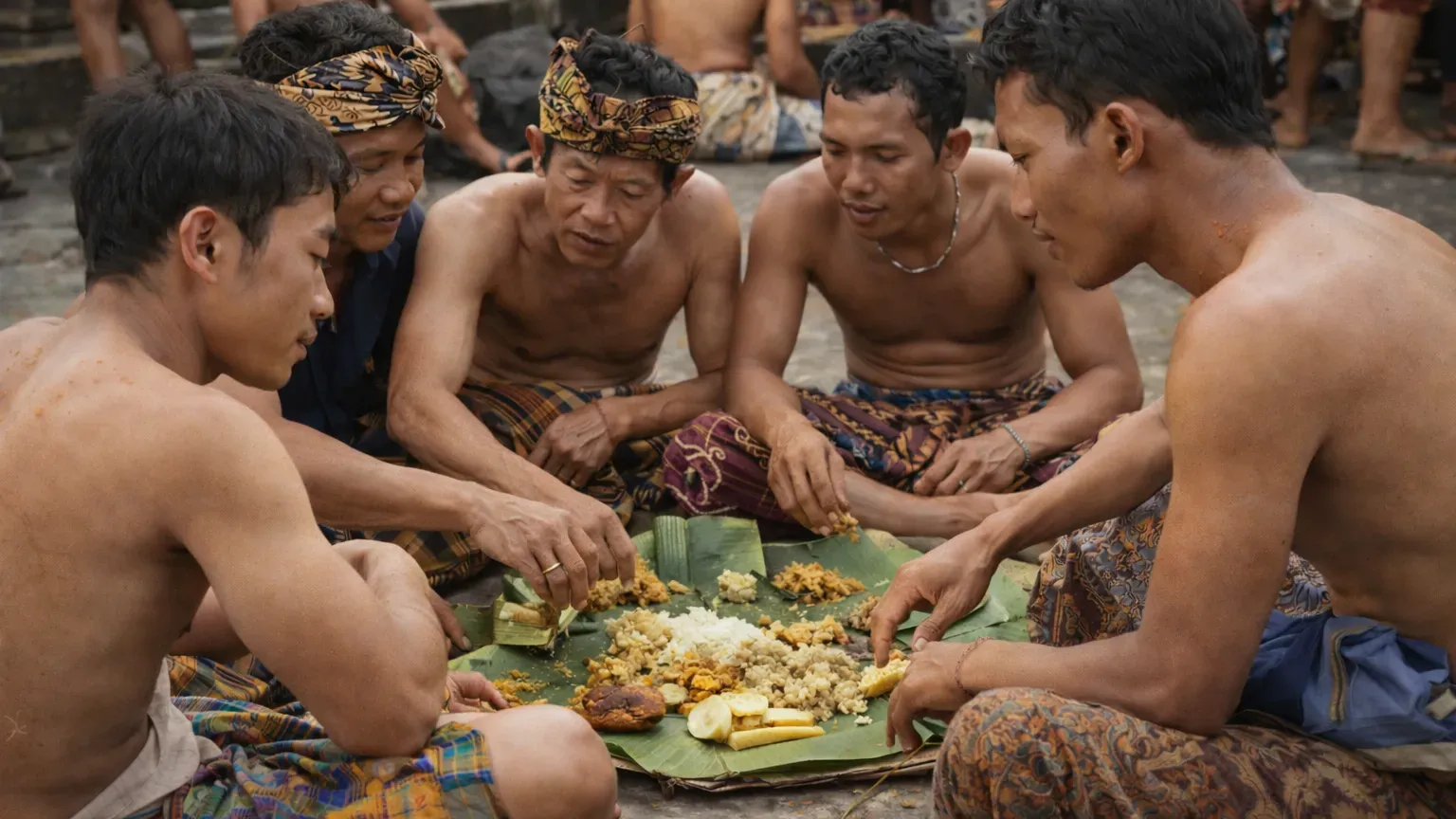
Megibung is a unique Balinese communal dining tradition originating from the Karangasem Regency. Introduced in 1692 by King I Gusti Agung Anglurah Ketut Karangasem, it involves a group of people (or even just two) eating from one shared plate (a nare, piring or nampan). More than just a meal, Megibung is a symbol of equality, brotherhood, and intimacy, where everyone eats with their hands, regardless of social status.
A Memory Carved in Wood and Rice
As a local born and raised in Bali, my earliest memory of "Megibung" isn't from a grand temple ceremony or a lavish wedding. It dates back to my primary school days, trekking through the bushes with my best friend to collect firewood.
We didn't have much, just two kids, a bundle of wood, and the humble lunch boxes our mothers had packed. But we wouldn't eat separately. We would spread out a leaf or use a single plate, mixing our side dishes together. To us, sharing that one plate meant we were brothers. In Bali, we believe that when you eat from the same vessel, your hearts become one.
The Royal Roots: A Legacy of the 17th Century
While I learned the spirit of Megibung in the forests of my childhood, the history of this tradition is quite grand. It was established around 1692 AD (or 1614 Caka) by the legendary King of Karangasem, I Gusti Agung Anglurah Ketut Karangasem.
Historical records (from karangasemkab.go.id) suggest that the King introduced this during his military campaigns. To ensure his soldiers felt valued and unified, he sat down to eat with them from the same shared portions. By doing this, he broke the barriers of "caste" and "rank." In that circle of food, there was no King and no servant, there were only people sharing a blessing.
More Than a Meal: How Megibung Works
For a traveler visiting Bali, seeing a Megibung session might look chaotic at first, but it is actually a beautifully choreographed ritual of respect.
- The Shared Plate: Traditionally, a large mound of rice is placed in the center of a circular tray, surrounded by various Balinese delicacies like Lawar (minced meat with vegetables), Sate Lilit, and spicy sambals.
- The Power of Hands: We don't use spoons or forks. We use our right hands. There is something incredibly "human" about feeling the texture of the food before it reaches your mouth; it connects you to the earth and the meal in a way plastic utensils never could.
- The Rule of Two or More: While official ceremonies usually have groups of 5 to 8 people, in my eyes, even two people sharing a single plate is Megibung. It’s the act of sharing, not the number of people, that counts.
- Wait for the eldest/host. It is polite to wait for the oldest person or the host to take the first bite before you begin.
- Don't leave the circle early. Try to finish at a similar pace as the others. If you must leave, ask for permission politely.
Why You Should Experience It
If you visit Bali, you will see many beautiful sunsets and beaches. But to truly "taste" the soul of the island, you must try Megibung.
In a world that is becoming increasingly digital and isolated, Megibung is a reminder of our shared humanity. It forces you to put down your phone, look the person next to you in the eye, and share a physical space. It’s a practice in mindfulness and communal joy. When you sit in a Megibung circle, you aren't just a tourist; you are a guest at our table, a friend in our circle.
Megibung Etiquette: A Traveler’s Guide to Sharing a Plate
To the local Balinese, Megibung is a sacred act of brotherhood. If you are invited to join a circle, following these simple unwritten rules will show great respect for our culture:
DO:
- Use your right hand. In Bali, the left hand is traditionally considered "unclean." Always scoop, mix, and eat with your right hand.
- Wash your hands before and after. Usually, a bowl of water (kobokan) is provided. Use it, cleanliness is part of the ritual.
- Take small portions. Start with a little bit of rice and side dishes from the side closest to you. You can always take more later!
Dont:
- Don't drop leftovers back. If you’ve taken a bite of something, do not put the remains back into the shared tray.
- Don't talk too much while chewing. While it’s a social event, try to keep the conversation light and respectful of the food being shared.
- Don't "scavenge" for the best bits. Avoid picking out only the meat or your favorite parts from the center; eat what is in front of you.
Final Thoughts
The next time you find yourself in Karangasem or a local Balinese village, look for the word Megibung. It is an invitation to be part of a 300 years old story of peace and friendship.
So, I have to ask: Have you ever experienced Megibung? Or perhaps, in your own culture, do you have a way of sharing food that brings people closer together? I’d love to hear your stories.